The Implats Group
Our business strategy
 Our four strategic pillars underpin
the Group strategy
Our ability to deliver on our four strategic objectives is impacted on an ongoing basis by the risk environment in which we find ourselves as a business.
People management is headed by a dedicated Group executive reporting to the CEO
 |
|
Safe and effective people who respect
and care for each other |
We will achieve this by
- Improving safety and health through implementing safety and health strategies
- Implementing an effective people strategy
- Attracting, retaining and developing talent and skills.
Why this is important
- Ensuring the safety and health of our employees, contractors and suppliers is essential if we are to respect their most fundamental human rights; without a meaningful commitment to respecting the rights of those with whom we interact, we will have no social or political licence to operate
- If we are to create sustainable value for shareholders and society we need our people to be healthy, safe, motivated and equipped with the requisite skills and abilities; this requires a work environment informed by mutual trust, respect and care.
How we manage this objective
- People management is headed by a dedicated Group executive reporting to the CEO; his scope of work includes remuneration, human resource development, talent management and employment equity. The Group health and safety (H&S) executive is a member of the executive committee (Exco) and is responsible for guiding the Group strategy on H&S issues
- Policies and procedures on people management issues are established at corporate level and apply at our operations. These seek to ensure the continuous development of our employees, in line with business demands, while at the same time offering career progression opportunities with particular emphasis on historically disadvantaged South Africans (HDSAs) within our South African operations
- Each operation has a transformation committee made up of representatives drawn from management, trade unions, women and people with disabilities, as well as other stakeholder groupings that we engage with to advance transformation at each operation
- Group and site-specific H&S policies, procedures and standards have been set, with the aim of ensuring that our activities comply with legislative requirements. Responsibility for implementing Group-wide H&S policies and procedures rests at an operational level with line management. The operations submit quarterly performance reports to the board appointed HSE (health, safety and environment) committee. HSE specialists, at a Group and operational level, support line management in implementing their strategy, and in monitoring and managing performance.
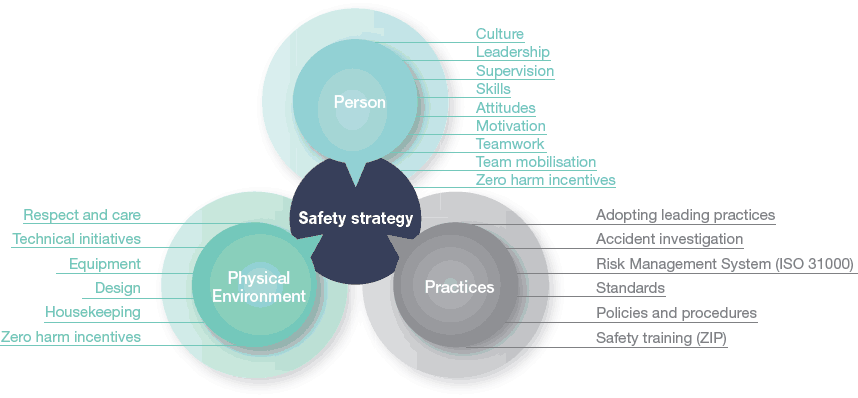
The diagrams below depict our Group-wide safety strategy.
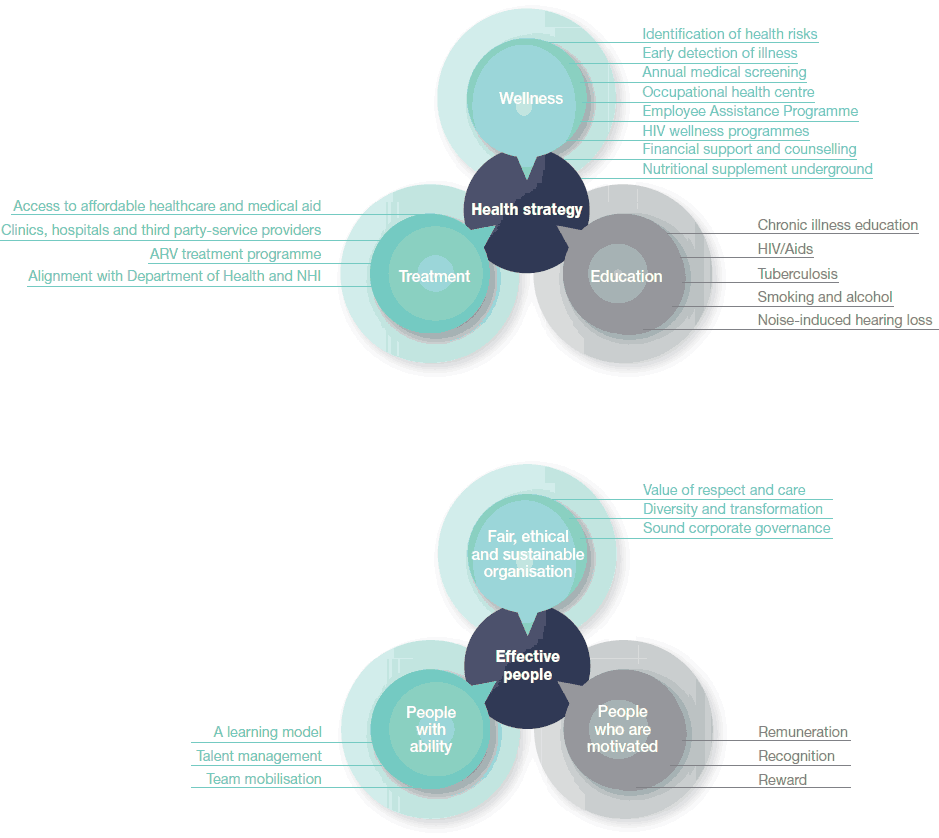
The following diagrams depict our health and people strategies.
Lost-time injury frequency rate (LTIFR) improved by 7%
Our 2014 performance
Safety
- Four work-related fatalities (2013: nine)
- Fatal injury frequency rate (FIFR) improved by 34% to 0.043 (2013: 0.065)
- Lost-time injury frequency rate (LTIFR) improved by 7% to 3.92 (2013: 4.21)
- The Group completed a total of 810 138 breathalyser tests, an increase of 22%, 52 527 road behaviour checks, an increase of 24.2%, and 73 444 STOP® visible felt leadership observations, an increase of 2.6%
- A notable achievement was the full implementation of nets and bolts on both the Impala Merensky Reef and UG2 Reef horizon stopes
- All development ends are also using safety nets
- Nets and bolts are fully implemented at the Marula operation
- The South African operations have now equipped the whole of the trackless vehicle fleet with Proximity Detection Systems and we plan to initiate a programme to equip underground locomotives with this technology commencing in 2015
- All underground employees have been equipped with self-contained self-rescuers
- A decision was made to replace the entire centralised blasting system at Implats to improve safety and reliability. The South African operations have chosen the Sasol SafeBlast® system used in conjunction with the SafeStart® detonators. The system has also now been installed at Marula, Mimosa and at the Impala 20, 16, 6, E&F, 7A and 4 Shaft complexes
- Zimplats has fully installed a similar system called Electronic Centralised Blasting system supplied by AEL
- All conveyor belts will eventually be replaced with fire retardant conveyor belts
- A fully revised methane management plan and associated initiatives were further developed to cater for increased flammable gas intersections being encountered on some of the deeper shafts at Impala (No 11, 11c, 14, 16 and 20 Shafts).
Health
- Employee health has received renewed focus and attention during 2014, with 59 322 employees and contractors (2013: 90 000 employees and contractors) undergoing occupational screening examinations during the year across the Group. This was lower than last year due to the prolonged strike at Rustenburg, which by year end had resulted in a backlog of occupational examinations
- No employee is allowed to work underground without a valid certificate of fitness and the backlog has been addressed post year end as part of the start-up of operations in Rustenburg
- For non-occupational healthcare, medical aid membership of the Impala Medical Plan increased by 7.8% and there are now 21 994 people (2013: 20 386 people) on the scheme
- The antiretroviral uptake increased by 6% (2013: 13.5%) in 2014 and there are now 4 276 people (2013: 4 039 people) on the programme
- Initiatives to mitigate against noise-induced hearing loss include the silencing of machines, the provision of custom fitted hearing protection devices, audiometric screening of all employees and the reporting and counselling of all early 2.5% to 5% and 5% to 9.9% noise-induced hearing loss cases
- Compliance to the wearing of the customised, fitted hearing protection received attention but is still not at the required 100% level and additional programmes are in place to improve in this area
- Alignment with the Department of Health and National Health Insurance continued. Following renovations to the Job Thabane Hospital Neonatal Unit and the Freedom Park Clinic, Impala has now entered into agreements with the Department of Health and the Impala Bafokeng Trust to extend and renovate the primary care clinic situated in Luka village
- In Zimbabwe, Mimosa mine has assisted with renovations to the Zvishivane district hospital and Zimplats assisted with the renovations to the Selous community clinic.
We aim to address potential skills shortages
through in-house technical trainee programmes
Our objectives
- Retain strong focus on cultural transformation framework, increasing supervision and leadership skills and introducing best practice technical initiatives
- Zero fatalities and zero harm
- Further develop leading indicators and the safety weighting have been increased in short-term incentive schemes and in so doing improve performanc
- Intensify efforts on ensuring further mitigation of risks relating to occupational chronic illnesses, HIV/Aids, as well as noise-induced hearing loss (NIHL)
- Access to effective, affordable healthcare
- Ensure alignment with the SA Government's national health strategy, including providing healthcare facilities around our mining areas
- Implement the employee engagement model and develop values through the “Exchange for Change” programme based upon the Respect, Care and Delivery initiative
- Address potential skills shortages through in-house technical trainee programmes, capacity-building at supervisory and managerial level, and enhanced peopleleadership initiatives
- Allocate an additional 1.5% salary adjustment to middle and senior management who possess critical skills
- Focus strongly on local employment.
 |
|
Deliver operational excellence and continuous improvement |
We will achieve this by
- Implementing the operational excellence model, which includes a new mineral resource management initiative
- Maintaining an intense cost and productivity focus.
Why this is important
- Delivering consistent returns through optimised operations, with a focus on mining quality is essential to rewarding those who invest their capital in our business and to secure their continued support. Superior returns ensure that we have access to capital and to borrowings with which we finance new operations
- Profits enable us to invest in our human resources, to motivate our staff and to keep contributing to the development of well-functioning sustainable communities and to the economic growth of South Africa and Zimbabwe.
How we manage this objective
- A robust annual budgeting process is undertaken with a strong focus on cost containment and safe production levels
- Performance against this budget is monitored continually and reported in detail on a monthly basis to Exco and on a quarterly basis to the board
- Planning and executing on optimal mine designs
- Increasing on-mine motivation and increasing the skills and knowledge of our teams.
Our 2014 performance
IMPALA
- The five-month strike interrupted a good start to the financial year and all initiatives to ramp-up production at the mine over the next five years were affected
- Ore milled decreased by 43.3% to 6.2 (2013: 10.9) million tonnes while platinum refined decreased by 42.0% to 411 000 (2013: 709 200) ounces
- Milled head grades (6E) were marginally higher at 4.34 (2013: 4.32) grams per tonne
- The Merensky: UG2 split remained at 44:56, and will not change significantly until 20 Shaft reaches full production
- Total development activity at 61.3 (2013: 97.4) kilometres decreased as did on-reef development, which decreased by 28.9% to 21.1 (2013: 29.7) kilometres
- The mine is currently still constrained at 20.5 kilometres of mineable face length and in the period before the strike commenced, 17.4 kilometres of face was mined at an average panel length of 24.1 metres and a face advance of 9.9 metres per month
- The key to reversing this situation and improving reserve flexibility is to optimise development, equipping, construction and ledging activities on existing shafts and at the newly commissioned 20 and 16 Shaft complexes
- Impala's unit costs were adversely affected by the strike and resulted in the R22 036 per refined platinum ounce reported, a 27.8% increase on 2013's R17 241. The strike, above inflation wage increases, lower productivities and above inflation power costs (in conjunction with lower volumes) all affected unit costs.
 |
Ore milled at Impala decreased by 43.3% to 6.2 million tonnes |
|
At Zimplats, over US$64 million was spent on Phase 2
expansion project |
 Integrated Annual Report 2014
Menu


