Integrated Annual Report 2014
Menu
AT A GLANCE THE IMPLATS GROUP GROUP PERFORMANCE
OPERATIONAL REVIEW GOVERNANCE AND REMUNERATION SUMMARY CONSOLIDATED ANNUAL FINANCIAL STATEMENTS
SHAREHOLDER INFORMATION AND ADMINISTRATION OTHER LINKS Report selector
X

Group Performance
Non-financial performance

The Group performance on non-financial indicators for 2014 is outlined below

A detailed account per operation can be obtained in the sustainable development report.

Our 2014 safety performance

It is with deepest sympathy that we report that four of our employees died at our operations during 2014. Two fatalities were caused by falls of ground, one involved a locomotive and another involved a fatal electrocution. We have undertaken investigations into the root causes of these fatal incidents and have implemented remedial actions.

This decrease in fatalities from nine last year (and 12 in 2012), coupled with the continuing reductions in our fatality rate, reflects some of the steady improvements in performance that we have achieved as a result of our strong focus on safety. Despite this progress, our performance tracked against a set of lagging and leading indicators, has been variable and we acknowledge that there is still much work to be done.

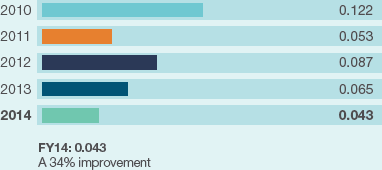
  • The Group fatality rate improved to 0.043 per million man-hours worked, from 0.065 in 2013
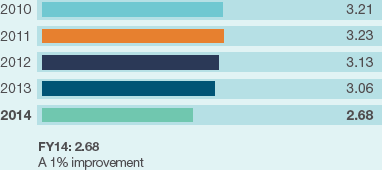
  • The lost-time injury frequency rate per million man-hours (LTIFR) decreased to 3.92 from 4.21 in 2013
  • The total injury frequency rate (TIFR) – a measure of all recorded injuries, including fatalities, lost-time injuries, restricted work cases and medical treatment cases – was 11.90, up from 10.91 in 2013
  • The serious injury frequency rate improved to 2.69 per million man-hours from 3.06 in 2013.

OUR SAFETY FOCUS FOR 2015 AND BEYOND

We have prioritised the following strategic objectives and focus areas for safety in the year ahead:
  • Culture shift: Shifting the safety culture through leadership, using the Chamber of Mines Five Pillar Cultural Transformation Framework (CTF), remains an ongoing priority. This will include using opportunities presented through the revised health and safety agreement with all employee representative groups, to engage more effectively with employees in promoting the right safety culture
  • Normalise the industrial relations environment: From a safety perspective, we will ensure that senior management engage with supervisors to contextualise the recent and ongoing challenges and provide support for effective supervision. We will continue to pursue interactions with senior union leadership to gain commitment for safety initiatives
  • Supervision and technology: In seeking to mitigate safety risks in the workplace, an ongoing focus is to increase supervision and leadership skills and implement best practice technical initiatives
  • Safety performance measures: We will further develop leading indicators and have increased the safety weighting in short-term incentive schemes
  • Targets: In striving for zero fatalities and zero harm, we will continue to focus on ensuring that all operations have behaviour-based safety programmes in place. Each operation is expected to achieve at least a 20% improvement in their LTIFR performance. In addition, we will strive to achieve: 100% compliance with road behaviour; 100% compliance with platinum rules or 100% disciplinary action for non-compliance to these rules.

FIFR (per million hours worked)

LTIFR (per million hours worked)

RIFR (per million hours worked)


The number of occupational medical examinations conducted this year was 59 322
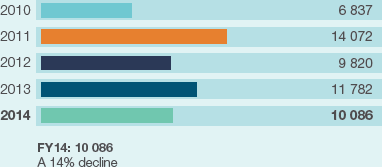
During the year, we undertook 10 086 HIV tests on employees (2013: 11 782)

Our 2014 health performance

  • General health indicators: The number of occupational medical examinations conducted this year was 59 322, as compared to 90 440 last year. The significant drop is primarily due to the closure of the Rustenburg Occupational Health Centre during the five-month strike, during which only exit examinations and examinations of essential services personnel and certain supervisors were conducted. No previously unknown occupational illnesses were detected in the Group this year
  • Noise-induced hearing loss (NIHL): In 2014, 36 cases of NIHL were diagnosed and submitted for assessment for compensation, as compared to 50 in 2013. While the decrease is partly due to reduced levels of medical and audiometric screening examinations during the strike period, encouraging improvements across all parameters of our NIHL performance were achieved in the months before the strike. Introduction of equipment with improved sound suppression continues and exposed individuals are trained in the use of custom-made hearing-protection devices. All patients diagnosed with early signs of NIHL (5 to 9.9%) on screening audiograms were investigated, counselled and monitored.
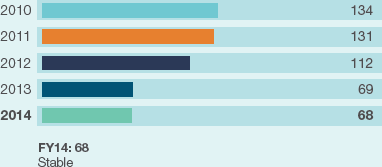
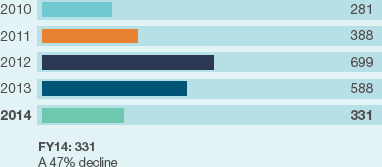
  • HIV/Aids: We have an HIV/Aids policy that covers activities across all our operations. The policy ensures patient confidentiality, non-discrimination and highlights our commitment to ARV treatment programmes. We proactively managed challenges faced during the strike period and have made good progress this year in managing HIV/Aids and TB in the Group. In particular, ARV uptake exceeded our business plan target of 5% growth. During the strike, a major focus at our Rustenburg operations was to strive to ensure that HIV patients on wellness and ARVs remained compliant to treatment. Impala clinics and the hospital continued to operate normally throughout the difficult period, albeit with reduced staff and patient numbers. IT systems were used to track when a patient had missed a script collection and these patients promptly contacted to ensure compliance with treatment. Those patients on ARVs that were deemed to be non-compliant and classified as unfit will receive necessary treatment and care before being permitted to return to work. During the year, we undertook 10 086 HIV tests on employees (2013: 11 782). Over the year a total of 6 286 employees benefited from Company funded and managed HIV wellness programmes (2013: 6 014), of whom 4 276 (2013: 4 039) received antiretroviral therapy (ART). Altogether, 982 of those on ART joined the ART programme during the year. The number of employees receiving ART through external medical aids or government health facilities is not known and so these figures may be underestimated. Regrettably 68 employees passed away due to HIV-related illness during the year (compared with 69 in 2013), while an additional 331 patients applied for medical incapacity and left the Group (2013: 588)
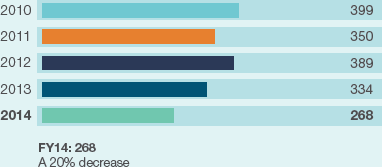
  • Pulmonary tuberculosis (TB): In managing TB in our workforce we adhere to the national guidelines and made good progress this year, achieving all our targets. A new diagnostic protocol for TB diagnosis using Polymer Chain Reaction (PCR) testing is in place and is assisting in more rapid and accurate diagnosis and in determining primary treatment sensitivity. We have negotiated price reductions for the tests but these remain high compared to state tender price and we are in discussions with the Department of Health (DoH) in this regard. During the year, 268 new cases of pulmonary TB were detected (2013: 334), of whom 70% are HIV-positive. Our incidence rate of 841 per 100 000 employees at Rustenburg is below the South African population rate of 1 003/100 000. Multiple drug-resistant TB in southern Africa remains a concern; this year we had 11 cases on treatment at Rustenburg. PCR testing has improved controls and this is being closely monitored.
  • Malaria: In 2014, 33 cases of malaria were diagnosed at Impala Rustenburg and 11 at Zimplats. All of these patients had recently travelled to malaria endemic areas and were successfully treated. The malaria vector surveys we conducted at the Ngezi operations in November 2013 indicate that it not a malaria endemic area
  • National Health Insurance (NHI): Impala and Marula continue to work closely with the SA Department of Health (DoH) in support of the NHI plan. This year a Memorandum of Understanding (MoU) was signed with the DoH, which allows appointed Impala medical personnel and forensic medical experts to attend post-mortem examinations. This will greatly assist in determining the medical causes of death where the cause is not obvious. Through the Impala Bafokeng Trust (IBT) we have committed to renovate and expand the Luka Clinic on the Impala lease area; an MoU has been signed and building will start in the 2015 financial year
  • Medical aid and non-occupational medical care: This year the Impala Medical Plan (IMP) received 1 037 new applications and membership increased by more than our targeted 5%. Currently, membership levels are 21 994. The cost of external medical schemes is becoming prohibitive for many employees and we strive to ensure that the IMP delivers cost-effective and affordable private healthcare to employees and dependants.
Our health focus for 2015 and beyond

We have prioritised the following key focus areas for health in the year ahead:

  • Delivering on our strategic priorities:
    • Striving for zero harm
    • Ensuring further mitigation of risks relating to tuberculosis, HIV/Aids, as well as noise-induced hearing loss (NIHL)
    • Promoting access to effective, affordable healthcare
    • Ensuring that our health strategy is aligned with the South African Government's national health strategy, including assisting with the provision of healthcare facilities around our lease areas
  • Noise-induced hearing loss: We will continue to have annual audiometric screening examinations to detect deterioration of hearing early and before permanent NIHL develops. Any employee who shows signs of early hearing loss of between 5% and 10% will undergo a formal evaluation and safety investigation. We will continue to track and investigate all cases of early NIHL. Employees showing an early hearing loss shift of between 2.5 and 5% will undergo formal counselling on the risks of noise, the importance of wearing Hearing Protection Devices (HPD) and the implications of NIHL. Action will be taken against employees who have been counselled and are found without HPD in the designated areas. We will continue with our programme of silencing machines across the Group and with our buy quiet policy of only purchasing machines and equipment that emit noise below 110dB.

NIHL

VCT interventions

ART

HIV/Aids death in service

Medical incapacity

Pulmonary TB


This year the Impala Medical Plan (IMP) received 1 037 new applications

Our principal focus during the reporting period has been on addressing the issues associated with the intense rivalry between AMCU and the NUM, and dealing with the outcome of the wage negotiations with AMCU

Our 2014 performance on people management

Our 2014 performance on employee relations

Our principal focus during the reporting period has been on addressing the issues associated with the intense rivalry between AMCU and the NUM, and dealing with the outcome of the wage negotiations with AMCU and the subsequent five-month strike in Rustenburg. While we made some initial progress early in the reporting period in delivering on our employee relations commitments made last year – relating in particular to improving employee communications and delivering on our shared corporate values initiative – these initiatives were significantly impacted by the strike.

Prior to the strike, we devoted considerable time and resources to ensuring a smooth transition from a work environment dominated by NUM, to one dominated by AMCU. The de-recognition of NUM and the associated litigation processes lasted approximately five months, at the end of which we began the lengthy process of negotiating a recognition agreement with AMCU. The signing of this agreement in June 2013 paved the way for the beginning of the first wage negotiations with AMCU in respect of the Rustenburg operations. Unfortunately we were not able to deliver on our efforts at establishing a multi-union dispensation with a lower threshold and the avoidance of a 'winner takes all' majoritarian system. Through our engagements with government and other stakeholders we will be continuing to pursue the implementation of a democratic labour dispensation.

While the strike in Rustenburg had an obvious profound impact on the achievement of our strategic objectives relating to employee relations, some progress was made in certain areas.