Business model – building resilience through innovation and technology
ENABLING A BETTER FUTURE THROUGH AND BEYOND MINING
Implats' business model is continuously evolving through innovation and technology, which are central to transforming inputs into outputs and outcomes that fulfil the Group's strategic purpose. In the short, medium and long term, innovation is reshaping how Implats operates across its value chain – enhancing productivity, managing emerging risks and supporting sustainable development.
Significant shifts have been identified to elevate the Group's innovation and technology profile, particularly in information technology (IT) and operational technology (OT). These capabilities are critical to:
- Driving production efficiency
- Safeguarding against cyber threats
- Supporting Implats' ambition to create a better future through and beyond mining.
ENABLERS OF INNOVATION
Implats' ability and appetite to innovate are shaped by:
- The operating environment (refer to our external environment)
- Access to capital and technical expertise
- Availability of critical skills
- Regulatory frameworks and the attitude of capital providers toward innovation.
These factors influence the pace and scale at which innovation can be adopted across the Group.
INNOVATION AND GOVERNANCE
The Implats board recognises innovation as a strategic enabler and integral to the Group's purpose, values and long-term sustainability. Innovation is prioritised in board-level decision-making, including:
Strategic direction
Risk appetite
Resource allocation
Board oversight ensures that Implats is positioned to seize opportunities and manage risks associated with technological change. (Refer to Chapter 3 for board composition, leadership profiles and deliberations.) Innovation initiatives begin with research into market forces and global signals shaping the future of mining. These insights inform high-level implementation plans and preliminary financial forecasts, including payback periods, which are presented to the board for evaluation and approval.
INNOVATION FRAMEWORK
Execution and accountability
The Group executive committee is responsible for executing strategy and supporting the board in day-to-day operations. Innovation themes and initiatives are cascaded from the CEO's deliverables to the broader executive team and management. These initiatives are embedded in performance metrics and linked to remuneration and incentives. (Refer to managing performance through remuneration).
To ensure robust governance and operational resilience, direct oversight is enhanced through the role of the Group chief information officer (CIO), who reports to the chief financial officer and provides quarterly updates to the audit and risk committee. These updates include insights into information and communications technology (ICT) governance, emerging cyber threats and the effectiveness of digital risk controls.
Implats' digital governance is underpinned by a comprehensive protection of personal information policy, aligned with South Africa's POPIA legislation. This policy governs the responsible processing, storage and use of personal data, ensuring integrity and confidentiality across all operations.
Key initiatives during FY2025 included:
- Cyber security awareness training rolled out across the Group
- Annual impact assessments of potential cyber breaches on data and operational technology systems
- Independent audits and penetration testing conducted by external specialists
- Clear escalation protocols for incident response and breach management.
Collaboration and partnering
In alignment with UN SDG Goal 17, Implats embraces collaboration as a catalyst for innovation. Partnerships – both internal and external – bring together diverse skills, perspectives and resources, enabling shared learning and accelerating progress.
This includes collaboration:
- Across operations and departments
- With technology providers, research institutions and industry peers.
Outcomes-based innovation
Implats adopts an outcomes-based approach to innovation, structured around defined themes and time horizons that align with the Group's strategic priorities. This framework ensures that innovation is purposeful, measurable and capable of delivering value across the short, medium and long term.
Innovation themes are designed to address material risks, support strategic objectives and strengthen the Group's intellectual capital – the systems, knowledge and capabilities that enable continuous improvement and long-term competitiveness.
Technology and digital transformation
Implats' information technology strategy is focused on unlocking value across support, compute, storage and security domains. Key developments include:
- Cloud adoption and application integration
- Formal cloud services implemented
- Migration of reporting landscape to SAP S4 Hana, with further investment planned for ERP systems
- Enhanced performance and near real-time data acquisition and reporting
- Data analytics
- Strategic focus on analytics, dashboarding and data science
- Exploration of outsourced services to accelerate capability
- Digitisation of business processes to support data-driven decision-making
- Process efficiency
- Introduction of robotic process automation (RPA) to streamline workflows and reduce manual effort.
Other key focus areas include:
- Cloud journey and application rationalisation
- Mobility and network communications (above and below ground)
- User experience and stakeholder engagement
- Internet of Things (IoT) integration
- Operational technology (OT) and IT convergence
- Cyber security posture enhancement.
These initiatives are embedded in performance metrics and linked to executive and management incentives, ensuring accountability and alignment with strategic outcomes.
This structured approach enables Implats to:
- Respond to immediate operational needs while building future-ready capabilities
- Mitigate key risks through targeted innovation
- Strengthen intellectual capital by embedding knowledge, systems and technologies that support long-term value creation.
Innovation themes
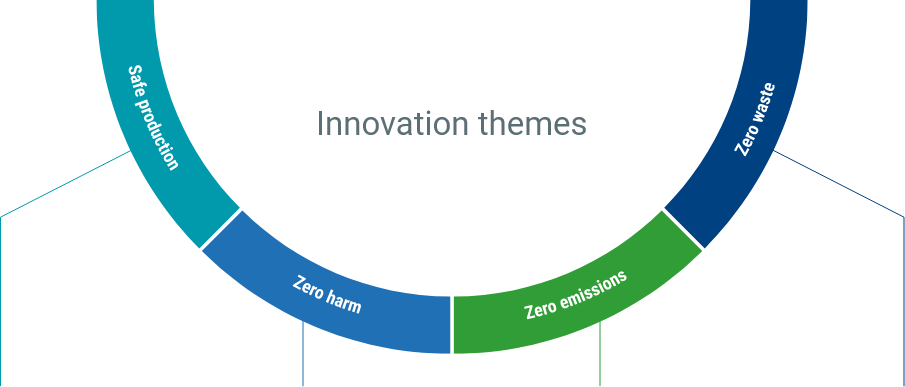
Safe production
Risks addressed:
2Deterioration in safety performance
4Maintaining optimal and harmonious labour relations
Strategies supported


- Connected mine (incremental change)
- Digital twinning
- Collision avoidance
- Hydro drilling
- IT/OT governance
- Big data analytics
- Asset tracking
- Advanced process control
- Predictive maintenance
- Field sensors
- Artificial intelligence
- Robotics
- Autonomous equipment
- Blockchain
- Integrated operations centre
Zero harm
Risks addressed:
2Deterioration in safety performance
4Maintaining optimal and harmonious labour
8Maintaining our social licence to operate and good stakeholder relations
9Failure to comply with legal and regulatory requirements
Strategies supported
- Mine modernisation
- Scraper winch advancements
- CCTV and surveillance
- Connected worker
- Proximity detection
- Mine health tracker
- Wearable tech
- Remote operations
- Predictive health and wellness
- Remote charging
- Remove people from harm
Zero emissions
Risks addressed:
5Cost and unreliable supply of electricity
8Maintaining our social licence to operate and good stakeholder relations
9Failure to comply with legal and regulatory requirements
Strategies supported
- Emissions mitigation
- Heat recovery
- Diesel particulate filters
- Renewable energy
- Alternative energy
- Fuel cell power
- Battery electric vehicles
- Battery storage
- Future energy systems
- Old shaft pump storage
- Fuel cell equipment
- Geothermal generation
Zero waste
Risks addressed:
6Failure to establish resilience around water scarcity
8Maintaining our social licence to operate and good stakeholder relations
9Failure to comply with legal and regulatory requirements
Strategies supported
- Waste mitigation
- Water recycling
- Wastewater treatment
- Energy metering
- Circularity
- Tailings to value
- Tailings retreatment
- Environmental impact mitigation
- Waterless mining
- Tailings elimination
- Non-explosive rock breaking
