Risks and opportunities

Implats' risk management process is designed to balance the mitigation of potential threats with the pursuit of opportunities that enable sustainable long-term value creation. Our ability to deliver on strategic and operational objectives depends on how effectively we anticipate, manage and respond to an evolving risk environment.

The Group's top 10 risks are largely within our control and are actively managed through value-driven operational strategies. However, two key risks – PGM market basket pricing and the exchange rate in Zimbabwe – remain largely uncontrollable in the short term. These are addressed through forward-looking strategies, including maintaining an optimal capital structure, ongoing portfolio optimisation and our future focus strategy. The interplay between these strategic levers enhances resilience to external shocks and underpins our ability to differentiate. These dynamics are further explored in Our potential for differentiation and our Value proposition.

RISK MANAGEMENT PROCESS

Implats identifies its strategic business objectives and material sustainability focus areas through a structured internal risk management process. This process integrates stakeholder perspectives and is aligned with the principles of the international risk management standard, ISO 31000:2018 and ISO Guide 73:2002, which define risk as 'the effect of uncertainty on objectives'.

Governance

Board
oversight
  • Implats' board is accountable for risk governance and ensures that a comprehensive understanding of associated risks informs strategic decisions. The board regularly reviews the Group's strategy in the context of its risk landscape.

Refer to board committee deliberations in Chapter 3 of this report.

Senior management
accountability
  • All Group risks – including those from subsidiaries and joint ventures – are reported to and reviewed by the audit and risk committee (ARC). Each material risk is assigned to a relevant board committee, which defines the risk appetite and tolerance levels for its area of oversight.

Refer to the risk allocation matrix below.

Enterprise risk
governance
  • The strategy and investment committee (SIC) receives quarterly updates on long-term and emerging risks
  • All board committees are responsible for monitoring emerging risks within their mandates
  • The board incorporates longterm and forward-looking risk assessments into the Group's strategy development and business planning processes
Risk management
execution
  • The Group's enterprise risk management (ERM) approach is underpinned by the combined assurance model
  • Operational risks are managed at the departmental level, with line managers accountable for identifying and mitigating risks
  • These risks are escalated to the relevant Exco member and monitored through key performance indicators (KPIs).
Risk process
integration

Risks that impact specific components of the business model – beyond those identified as material – are assigned to the ARC for oversight.

This ensures a holistic view of risk across the Group's value chain.

GROUP RISKS

Group risks are those that pose a threat to lmplats' business model, financial performance, solvency, liquidity and long-term value creation. These risks are assessed for their potential to disrupt the Group's ability to create, deliver and sustain value across its stakeholder ecosystem.

Risks with the potential for catastrophic consequences – those that could severely impact the Group's operations, reputation or financial stability – are assigned the highest priority risk rating and are subject to enhanced oversight and mitigation planning.

Implats Group risks description1 Ranking and movement Sustainability-related impact, risks or opportunity Risk concentration Key stakeholders directly impacted Risk controllability Metrics to monitor performance2 Targets Timeframe for likelihood of occurrence Governance and oversight (responsible committee and management accountability)
Lower-than-planned PGM basket pricing
1
– Industry and Group-wide All stakeholders U
  • EBITDA
  • Headline earnings
  • Free cash flow
  • Net debt to equity
1%-10% net debt to equity Short to medium term
  • Committee: ARC
  • Management: Group CFOs (refer to CFO's review)
Deterioration in safety performance
2
Social (employees and communities) SRO Group-wide Employees
Regulators
C
  • Number of fatalities
  • LTIFR
  • TIFR
Refer to the Group's short- to medium-term KPI targets here. Short to medium term
  • Committee: HSE
  • Management: Group COO; operational CEOs and executives (Refer to CEO's review)
Executing a safe and sustainable ramp up at Styldrift
3
– Impala Bafokeng Employees
Investors, shareholders
C
  • Production metrics
  • Unit cost per 6E ounce
  • Trackless fleet availability and utilisation
Refer to the Group's short- to medium-term KPI targets here, and the COO's review. Short term
  • Committee: SIC
  • Management: Impala Bafokeng chief executive and Group COO (Refer to COO's review)
Maintaining optimal and harmonious labour relations
4
Social (employees) SRO Southern African operations Employees and unions PC
  • Percentage of active workforce covered under collective bargaining agreements
  • Industrial action-related disruptions (days/production) lost
  • Pay equity, employee engagement levels, retention, diversity, equity and inclusion
Refer to the narrative performance disclosed in the remuneration section of this report and the social performance chapter of the ESG report. Short to medium term
  • Committee: STR
  • Management: Group Executive: People, COO and operational executives
Rising cost and unreliable supply of electricity resulting in business interruption
5
Environmental and social (host communities) SRO Southern African operations Suppliers
Customers
PC
  • Total electricity consumed (GJ) % electricity from renewable sources
  • Energy use efficiency (GJ/production measure)
  • Lost production due to unreliable electricity supply
  • Unit costs
  • Capital allocation toward renewable energy
Implementation of Group decarbonisation strategy by sourcing and pursuing alternative, low-cost, alternative clean energy sources. See more in the environmental performance chapter of the ESG report. Short to medium term
  • Committee: HSE
  • Management: Group COO and operational executives (refer to COO's review)
Failure to establish resilience around water scarcity within the southern African region
6

(previously ranked outside the top 10)

Environmental and social (host communities) SRO Southern African operations Communities
Customers
Investors/shareholders
PC
  • Fresh water withdrawn
  • M3 total water consumed
  • % water recycled
  • Water-related environmental incidents
Refer to the Group water and environmental performance targets in our sustainable development strategic pillar. Short to medium term
  • Committee: HSE
  • Management: Group COO and operational executives
Currency or exchange rate induced inflation and instability due to devaluation of the Zimbabwe Gold (ZWG)
7
– Zimbabwean operations Government and regulators
Suppliers
Investors/shareholders and other financiers
U
  • Foreign currency preservation
  • ZWG availability and disbursements by ministry
  • Cash balance analysis
  • Foreign exchange loss
  • Currency allocation in terms of allocation framework
Availability of currency, allocation and foreign exchange loss per the budget. Short, medium and long term
  • Committee: ARC
  • Management: Group CFO and Zimplats CFO (Refer to CFO's review)
Maintaining our social licence to operate and good stakeholder relations
8
Social (host communities) SRO Group-wide Host communities
Investors/shareholders
PC
  • Socio-economic development interaction and spend
  • Local community interaction, spend and job opportunities
  • Operational disruptions due to community unrest
Adherence to the Group social performance framework which is explained on the social performance chapter of the ESG report. Short, medium and term
  • Committee: STR
  • Management: Group Executive: People and operational executives
Failure to comply with legal and regulatory requirements through the value chain
9
Environmental and social (host communities) SRO Group-wide Regulators
Host communities
Investors/shareholders
C
  • Compliance with environmental licences, regulations and closure plans in Canada
  • Capital spend related to direct air emissions issues (SO2 in Zimbabwe)
  • SLP compliance
Full compliance with applicable laws and regulations. Short, medium and long term
  • Committees: ARC, STR and HSE
  • Management: Group COO and operational executives
Cyber security
10
– Group-wide Investors, employees, customers, suppliers and business partners C
  • Ransomware simulations
  • Intrusion and malware detections
  • Network, server and workstation security and back-up success rate
  • Security incidents and cyber security awareness training
No financial loss, disruption or reputation damage. Short, medium and long term
  • Committee: ARC
  • Management: Group chief information officer
1 Board committee refer to the audit and risk committee (ARC), the social, transformation and remuneration committee (STR), the health, safety and environment (HSE) committee and the strategy and investment committee (SIC). Refer to the associated board deliberations in Chapter 3 of this report.
2 These metrics are used to monitor the Group's performance against the risks and associated opportunities. KPIs were developed for each of the identified metrics. These were reviewed and approved by the Exco, and then allocated to management, with management plans incorporated into business plans. Performance disclosures are contained in the strategy and operational performance sections, and the capital outcomes section of this report. Additional information on social and environmental risks and opportunities is provided in the ESG report.

  1. 1Lower-than-planned PGM basket pricing
  2. 2Deterioration in safety performance
  3. 3Executing a safe and sustainable ramp up at Styldrift
  4. 4Maintaining optimal and harmonious labour relations
  5. 5Rising cost and unreliable supply of electricity resulting in business interruption
  6. 6Failure to establish resilience around water scarcity within the southern African region
  7. 7Currency or exchange rate induced inflation and instability due to devaluation of the Zimbabwe Gold (ZWG)
  8. 8Maintaining our social licence to operate and good stakeholder relations
  9. 9Failure to comply with legal and regulatory requirements through the value chain
  10. 10Cyber security

Residual risks

Group risks are managed by evaluating future expectations and the factors that contribute to the risk's potential occurrence.

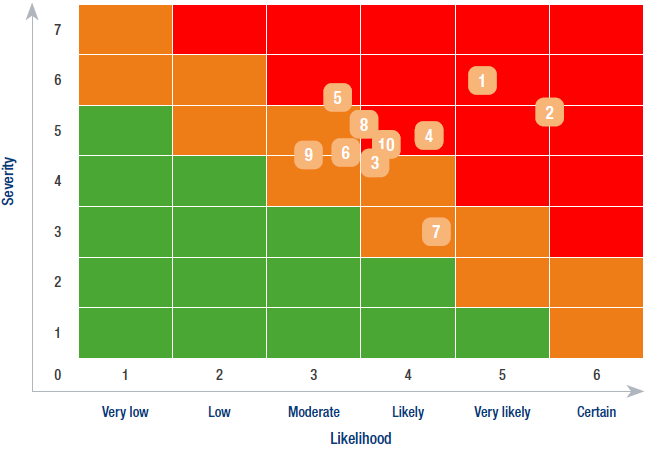
  • Risk owners assign residual risk ratings based on their assessment of the adequacy and effectiveness of current controls, short-term mitigation plans, and the degree of risk controllability. They are also responsible for positioning the risk on the Group's residual risk heat map
  • The Group's executive committee reviews and ranks the risks according to their outlook on each risk. The committee's ranking and the residual risk ratings provided by management are used to create the heat map above.

SHORT-, MEDIUM- AND LONGER-TERM OUTLOOK AND EMERGING RISKS

Implats operates in a complex and evolving risk landscape. Our ability to create sustainable value depends on how effectively we identify, assess and respond to both current and emerging risks across different time horizons.

Emerging risks are newly developing or future risks with uncertain impacts that are often difficult to quantify. In contrast, long-term risks are typically linked to existing trends that are expected to intensify over time or risks that are currently minor but may become material to the Group or broader society. These risks are reviewed quarterly by the SIC, based on inputs from management.

In addition to strategic and operational risks, Implats remains exposed to a range of external and systemic risks, which are expected to persist in the medium to long term, including:

  • Macro-economic volatility: Currency fluctuations and inflationary pressures
  • Social and environmental dynamics: Community relations, environmental impacts and evolving societal expectations
  • Regulatory and legal exposure: Litigation, regulatory compliance and policy shifts
  • Infrastructure and human capital: Reliability of critical infrastructure and availability of skilled talent.

These risks are expected to materialise gradually and influence the availability and quality of our key resources (impacts and outcomes). They also shape our value-added strategy, which is designed to mitigate risk while enabling long-term growth.

Our strategic objectives, as outlined in the strategy section, are structured to address these risks proactively. Each board committee has reviewed and confirmed that risk appetite and tolerance levels remain within acceptable thresholds.

Risks are embedded across all aspects of our business. Their impact on the use of capitals, resource allocation and trade-offs is discussed in the capitals section. The alignment of risks with strategic objectives, associated KPIs, and expected outcomes is detailed in the strategy section.

In the short term, we are closely monitoring our ability to pursue future-facing opportunities in a more capital constrained environment. This is particularly relevant in the context of limited growth potential for PGMs outside energy transition-linked commodities, where competition for future-aligned metals is intensifying. The Group is also prioritising limiting our exposure to low-quality assets and the successful unwinding of Impala Canada's operations.

All board committees maintain ongoing oversight of emerging risks relevant to their mandates. Prior to the approval of the Group's business plan, these risks and their mitigation strategies are presented to the board to ensure alignment with our capital allocation priorities and strategic outlook.