Organisational overview
Who we are and where we operate
Implats is a leading producer of platinum group metals (PGMs), structured around seven mining operations, refining and processing facilities, and a refining business, Impala Refining Services. The Group's mining operations span the Bushveld Complex in South Africa, the Great Dyke in Zimbabwe and the Canadian Shield.
Contributing approximately 20% to global primary PGM production annually, our nearly 64 000 people (employees and contractors at managed operations) form the cornerstone of our business. Guided by our core values – respect, care and deliver – we cultivate a culture rooted in teamwork and accountability.
Implats holds total attributable PGM resources of 315 million ounces. Our products are exported to many sectors in diverse markets, including Japan, China, the US and Europe, where they are integral to industrial, medical and electronic applications, supporting a cleaner, greener world.
Implats' primary listing is on the JSE in South Africa, and it has a secondary listing on South Africa's A2X and maintains a level one American Depositary Receipt programme in the US.
At 30 June 2025, our major shareholders included the Public Investment Corporation (PIC) (14.32%), Fidelity Management and Research Company (8.52%) and Lingotto Investment Management, LLP (6.51%), with the remainder of the stock held by various public and non-public shareholders (refer to the Group consolidated annual financial statements).
SEVEN OPERATIONS
Operational details, including each operation's strategic focus and key performance areas, outlook, value drivers, risks, value-added statement, stakeholder interests and five-year trend graphs are contained in Chapter 5 of this report.
Operational key statistics
Detailed operational statistics tables are available on our website.
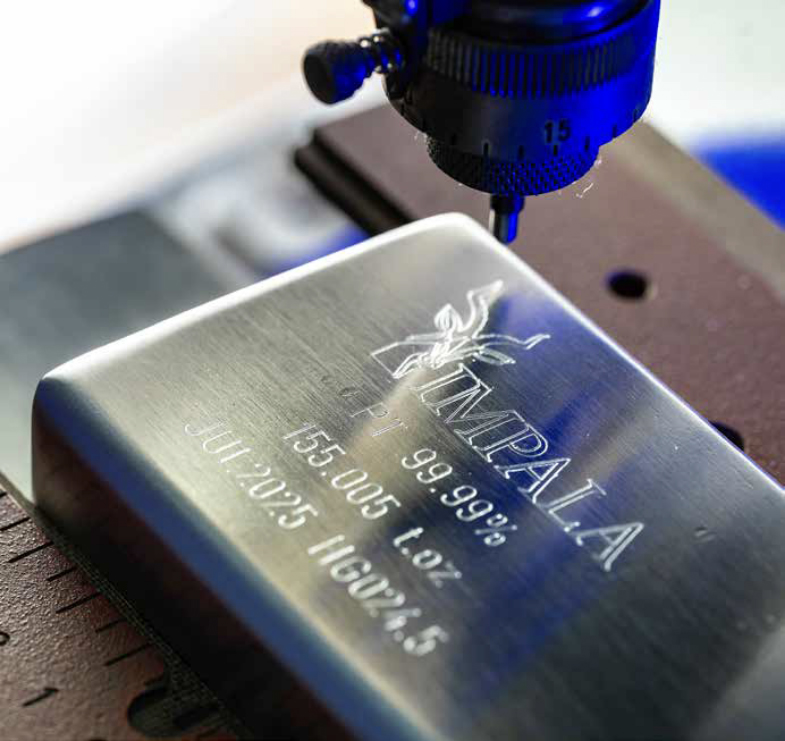
Our platinum group metals (PGMs)
Enabling cleaner technologies, advanced manufacturing and sustainable development.
Platinum group metals (PGMs) comprise platinum, palladium, rhodium, ruthenium, iridium and osmium, which are critical components in a wide range of industrial, environmental and technological applications. In industry and commerce, the focus is primarily on platinum, palladium and rhodium due to their economic significance, market depth, industrial and consumer applications and supply and demand patterns. Their unique catalytic and conductive properties, together with their superior durability, make them indispensable to modern life and the global transition to low-carbon economies. Ruthenium, iridium and osmium have more specialised, niche applications. PGMs are integral to developments in:
- Decarbonisation: Enabling the production, use and storage of sustainable energy
- Circular economy: High recyclability supports sustainable resource use
- Technological innovation: Powering next-generation electronic, medical and automotive devices.
PGM PRICING
PGM prices are set through the interplay of market dynamics, liquidity, supply-demand fundamentals and speculative financial market activity.
Here's a breakdown of how PGM pricing works:
Global commodity markets
- Platinum and palladium are traded on global commodity exchanges including the New York Mercantile Exchange (NYMEX), the London Metal Exchange (LME) and over-the-counter (OTC) markets. Rhodium, ruthenium and iridium are traded OTC
- Prices are influenced by daily trading activity, futures contracts and spot market transactions.
Supply and demand fundamentals
- Supply: Primarily from South Africa, Russia and Zimbabwe and complemented by the open-loop recycling of previously fabricated metals recovered from e-waste, auto catalysts and jewellery
- Demand: Driven by industrial uses (especially automotive catalytic converters), jewellery, investment demand and emerging technologies (eg, hydrogen fuel cells).
Currency movements
- PGM prices are typically quoted in US dollars, but producers such as Implats earn revenue in South African rand therefore, exchange rate fluctuations (USD/ZAR) significantly impact domestic producer economics.
Speculative and investor activity
- Hedge funds, institutional investors and commodity traders influence prices through speculative positioning
- Macro-economic news flows, shifting market sentiment, interest rate and inflation expectations and geopolitical developments can drive short-term price volatility.
Benchmark pricing and fixings
- The London Platinum and Palladium Market (LPPM) provides daily benchmark prices (known as 'the fix') for platinum and palladium, which serve as reference points for physical transactions.
-

AUTOMOTIVE
Autocatalysis reduces harmful emissions, FCEV offer zero-emission transport (platinum, palladium, rhodium)
-

JEWELLERY
Premium metal for luxury and bridal (platinum)
-

ELECTRONICS
Hard disks, thermocouples and electrical contacts (ruthenium, palladium)
-

HYDROGEN ECONOMY
Production, storage and end use of zero-emission hydrogen and adjacent feedstock (platinum, iridium)
-

INDUSTRIAL MANUFACTURING
Glass, chemical and petroleum refining catalysts (platinum, rhodium)
-

MEDICAL
Pacemakers, dental alloys and cancer treatments (platinum)
-

INVESTMENT
Physical bars, coins and exchange-traded products (platinum, palladium, rhodium)
Key
Pt – Platinum
Pd – Palladium
Rh – Rhodium
Ir – Iridium
Os – Osmium
Ru – Ruthenium
Our stakeholder outcomes – key highlights for the year
Outcomes are the internal and external consequences – positive and negative – of our business activities and outputs on our capitals.
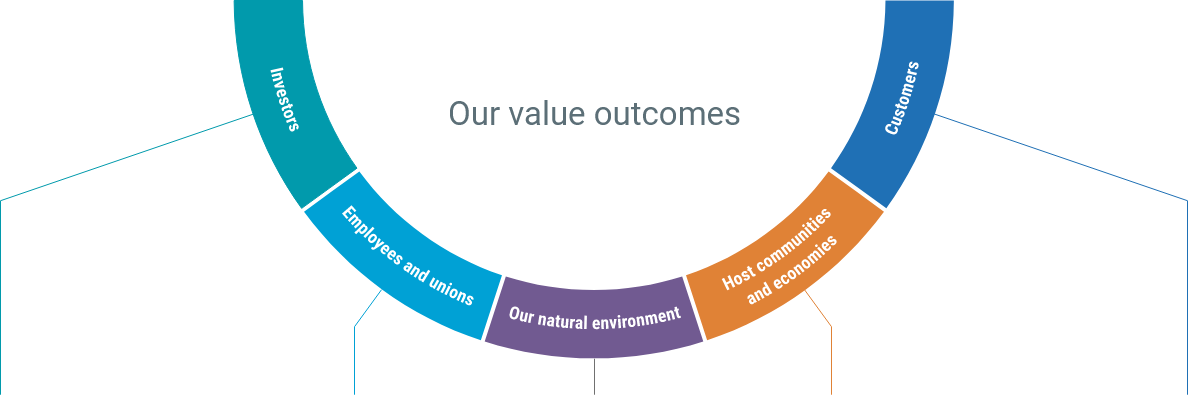
Our value outcomes
Investors
EBITDA of R9.9 billion at an EBITDA margin of 12%
Headline earnings of R732 million or 82 cents per share
Free cash flow of R2.4 billion
60% of adjusted free cash flow allocated to shareholder returns
Final dividend of R1.5 billion declared
Positive
- Strong cash generation from PGM sales
- Disciplined capital allocation and shareholder returns
- Access to funding for strategic growth
- Exposure to PGM price volatility
- Rising input costs and inflationary pressures
- Currency fluctuations and geopolitical risks
Negative
Employees and unions
Approximately 64 000 employees across managed operations
Labour restructuring concluded at Marula
8 fatalities
3.46 LTIFR (pmmhw)
R897 million spent on skills development
Positive
- Skilled and experienced workforce
- Investment in training and development
- Strong leadership and governance culture
- Proprietary processing technologies and operational expertise
- Innovation in decarbonisation and energy solutions
- Data-driven decision-making and planning
- Labour unrest or restructuring impacts
- Health and safety risks in mining environments
- Talent retention challenges in competitive markets
- Risk of IP leakage or underutilisation
- Technological obsolescence if not continuously improved
- Cyber security threats and data privacy concerns
Negative
Our natural environment
59% water recycled/reused
No major or significant environmental incidents
Five-year renewable electricity supply agreement (RESA) to replace up to 90% of Impala Refineries' electricity concluded in the current year
First 35MW of Zimplats' intended 185MW solar power complex commissioned, and 45MW Phase 2A approved
Positive
- Responsible mineral extraction supporting green technologies
- Water recycling and emissions reduction initiatives
- Transition to renewable energy sources
- Depletion of finite mineral resources
- Environmental degradation and biodiversity loss
- Carbon emissions and climate-related risks
Negative
Host communities and economies
R9.47 billion total tax contribution
R274 million socio-development spend (including donations)
R1.05 billion spent with local suppliers
Positive
- Strong community partnerships and trust
- Local procurement and job creation
- Industry collaboration and stakeholder engagement
- Tax transparency and responsible tax practices
- Community dissatisfaction if expectations are unmet
- Social licence to operate at risk from poor engagement
- Reputational damage from ESG controversies
Negative
Customers
96% overall customer satisfaction in most recent survey
Recognised as a responsible source of platinum and palladium by the London Platinum and Palladium Market (LPPM)
Certified conformant for responsible sourcing of all metals (PGMs, gold, silver, nickel, copper and cobalt) under the Responsible Minerals Assurance Process Standard
ISO 9001 quality management system certified
Positive
- Efficient, mechanised mining and processing infrastructure
- Expanded smelting and refining capacity
- Enhanced energy efficiency and throughput
- Good ESG performance
Negative
- Ageing infrastructure requiring ongoing investment
- Downtime from maintenance or power disruptions
- Reputational damage from ESG controversies
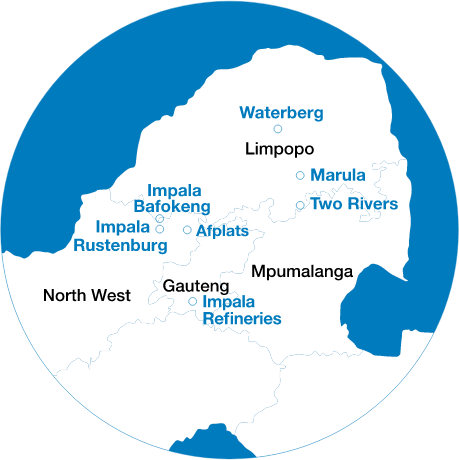
Our operations outcomes – key highlights for the year
Click on a country below for more information on our operations:
Canada
| Impala Canada | 6E in concentrate 237.4koz |
Life-of-mine 11 months |
Current average mining depth 922m |
Employees 724 |
|---|
Zimbabwe
| Zimplats | 6E in matte 606.3koz |
Life-of-mine 42 years |
Current average mining depth 150m |
Employees 7 679 |
|---|---|---|---|---|
| Mimosa1 | 6E in concentrate 253.9koz |
Mine-to-market receipts 8 years |
Current average mining depth 152m |
Employees 3 417 |
1 Non-managed.
South Africa
| Impala | 6E refined production 1.24Moz |
Life-of-mine 11 years |
Current average mining depth 870m |
Employees 40 381 |
|---|---|---|---|---|
| Impala Refining Services | 6E refined production 1.50Moz |
Mine-to-market receipts 1.3Moz |
Third-party receipts 208.6koz |
Employees Operated by Impala |
| Marula | 6E in concentrate 201.9koz |
Life-of-mine 7 years |
Current average mining depth 300m |
Employees 4 828 |
| impala Bafokeng | 6E in concentrate 481.3koz |
Life-of-mine 27 years |
Current average mining depth 332m |
Employees 10 281 |
| Two Rivers1 | 6E in concentrate 288.5koz |
Life-of-mine 21 years |
Current average mining depth 560m |
Employees 4 020 |
1 Non-managed.
