Managing performance through remuneration
Implats’ remuneration framework is a strategic lever for driving performance, enabling long-term value creation and aligning stakeholder interests. It is designed to reward delivery against the Group’s six strategic pillars, with a strong emphasis on safety, operational excellence, financial discipline and ESG outcomes.
In FY2025, remuneration outcomes reflected the Group's resilience in a challenging operating environment. Despite subdued PGM pricing and restructuring costs, Implats delivered improved cash flow, maintained a strong balance sheet and achieved significant safety gains. These achievements informed short-term incentive (STI) outcomes, which were moderated to account for external factors, while maintaining alignment with performance targets.
Executive and management performance is assessed through cascading balanced scorecards (BSCs), ensuring accountability and strategic alignment across all levels. The CEO's performance is representative of Group-wide delivery and is directly linked to shareholder value creation.
Remuneration practices also support inclusive value sharing through employee share ownership schemes and targeted interventions to improve pay equity. The STR committee remains committed to fair, transparent and responsible reward practices, with remuneration evolving to support future strategic shifts – including energy transition, mechanisation and leadership development.
For detailed disclosures, refer to the remuneration report and the performance and capitals sections of this annual integrated report.
Stakeholder impact of remuneration practices
Implats’ remuneration framework is designed not only to drive strategic performance but also to deliver meaningful outcomes for a broad range of stakeholders. By aligning reward with responsible leadership, operational excellence and long-term sustainability, the Group ensures that its remuneration practices contribute to shared value creation.
Employees
- Economic inclusion through ESOTs, with over R1.9 billion distributed to date
- Introduction of the GPAT scheme to supplement ESOTs during low-dividend periods, ensuring continued benefit sharing
- Ongoing efforts to improve pay equity, including annual fair-pay assessments and a planned job-based equal pay review in 2025
- Transparent performance management and incentive structures that reward contribution at all levels.
Shareholders
- Strong alignment between executive pay and shareholder value creation, with variable pay linked to financial, operational and ESG performance
- Responsiveness to shareholder feedback, including refinements to the fatality modifier, MSR policy and STI moderation
- Transparent disclosure of remuneration outcomes and governance, with 94.37% support for the remuneration policy and 95.23% for the implementation report at the 2024 AGM.
Communities and society
- Remuneration practices support the attraction and retention of leadership capable of delivering on transformation, diversity and inclusion goals
- Fair and responsible pay practices contribute to social stability and economic empowerment in host communities
- Safety-linked incentives reinforce the Group's commitment to zero harm, protecting lives and livelihoods.
Regulators and governance bodies
- Compliance with the Companies Amendment Act and King IV principles, including shareholder approval of remuneration policies
- Transparent, auditable processes for setting and reviewing executive and non-executive remuneration.
STRATEGIC ALIGNMENT OF REMUNERATION
Implats’ remuneration philosophy is designed to support the execution of its strategy and the delivery of sustainable value. Executive reward is aligned with the Group’s six strategic pillars, which guide performance evaluation and incentivise delivery against key performance areas (KPAs).
The Group’s value-focused strategy aims to position Implats as a high-value, sustainable, socially and environmentally responsible producer, with increasing exposure to low-cost, shallow and mechanisable assets.
Executive incentives and strategic alignment
To align executive performance with strategic delivery and stakeholder expectations, as determined through proactive engagement with shareholders and other stakeholders, incentives are heavily weighted towards senior employees, reflecting their ability to influence the Group’s strategic direction and long-term value creation.
Variable pay is directly linked to performance, with the proportion of incentive-based remuneration increasing with seniority. This structure reinforces Implats’ performance-based philosophy, where higher levels of responsibility and impact are rewarded through greater exposure to performance-linked incentives. The framework remained unchanged from the prior year.
REMUNERATION FRAMEWORK
| Reward elements and eligibility (FY2026) | Strategic intent | Measurement (bonus/variable pay) | |
|---|---|---|---|
Total guaranteed package (TGP)
|
|
|
|
Benefits
|
|
|
|
Short-term incentives
|
|||
| Executive incentive scheme (EIS) |
|
|
Targets are grouped and weighted as follows:
Group and operational performance is disclosed in part three of the remuneration report |
| Production bonuses |
|
|
|
Short-term incentives (STI)
|
|
|
|
Long-term incentives (LTI)
|
|
|
|
For more on strategic alignment, refer to the remuneration philosophy section of the RR.
Governance and oversight
The social, transformation and remuneration (STR) committee oversees the Group’s remuneration policies and practices, ensuring alignment with Implats’ strategic and operational objectives. This includes oversight of salaries, bonuses, benefits and incentives across short-, medium- and long-term horizons ensuring they are:
- Fair and transparent
- Aligned with performance and stakeholder expectations
- Responsive to evolving regulatory requirements, including the Companies Amendment Act.
For full details on remuneration structures, performance metrics and policy amendments, refer to the 2025 remuneration report.
The STR committee is supported by permanent invitees including the CEO, CFO and Group Executive: People, with external specialists consulted on policy and governance matters. These invitees do not participate in discussions regarding their own remuneration.
The committee also oversees broader people-related matters such as employee engagement, transformation, gender mainstreaming, diversity, management development and succession planning.
For detailed governance disclosures, refer to Chapter 3 of this report and the 2025 remuneration report.
Remunerating strategic delivery
This year, Implats’ remuneration policy supported strategic delivery through a combination of baseline, stretch and threshold targets, with KPIs linked to both Group and individual performance.
In FY2025, the STR committee focused on ensuring that remuneration practices remained market-aligned, performance-driven and responsive to stakeholder expectations, despite a challenging operating environment.
| Remuneration policy | Strategic alignment | Remuneration practices are aligned with the Group’s strategy, objectives and values, reinforcing the pay-for-performance principle. All awards (cash payments, deferred shares and LTI payouts) are subject to the malus and clawback policy |
|---|---|---|
| Governance and compliance | All awards – including cash payments, deferred shares and long-term incentives – are subject to the Group’s malus and clawback policy, and adhere to best-practice governance frameworks such as King IV | |
| Fair and responsible pay | The Group is committed to maintaining a fair, equitable, ethical and responsible remuneration framework for all employees, as outlined in our fair pay policy | |
| Market competitiveness | Total executive remuneration – including base salary, pension, benefits and incentives – is targeted at the median of the peer group for on-target performance, in line with market practice | |
| Performance calibration | Performance levels are assessed using a sliding scale to avoid binary outcomes.
|
Key contributions included:
- Talent management and executive succession planning
- Social performance and employee engagement
- Transformation and diversity initiatives
- Leadership development
- Stakeholder management
- Oversight of people-related aspects of the Impala and Impala Bafokeng consolidation.
Implats proactively engaged with shareholders to align evolving expectations, including those arising from the Companies Amendment Act, which introduces shareholder approval of remuneration practices. The Group remains committed to transparency, compliance and protecting shareholder interests.
Strong shareholder support at the 2024 AGM – 94.37% for the remuneration policy and 95.23% for the implementation report – reflects continued confidence in Implats’ remuneration practices and their alignment with strategic and stakeholder priorities.
Key developments and strategic adjustments
- Reward policy enhancements
In response to global skills shortages, the committee implemented changes to variable pay structures and performance metric weightings, aligned with the 2024 reward policy. These adjustments aim to attract, retain and motivate critical talent while reinforcing sustainable performance and shareholder value.
- Salary adjustment strategy
Due to depressed PGM pricing and margin compression, the Group deferred 2023-approved salary increases for middle management, executives and non-executive directors. Only medical aid rate adjustments were implemented, in line with bargaining unit agreements. Salary increases below middle management were fully honoured.
In FY2025, the committee approved a 5% increase mandate, with a staggered implementation of the deferred 6% increase from 2023. An additional 3% was allocated to high-performing employees, with the remaining 3% scheduled for 2026.
These adjustments are detailed in part 3 of the 2025 remuneration report.
- Employee sentiment and retention risk
Culture surveys and direct feedback highlighted dissatisfaction among middle management, exacerbated by a temporary 10% salary reduction at Zimplats. Although reinstated in May 2025, the reduction impacted morale and retirement contributions, increasing retention risk. These insights underscore the importance of rebuilding trust and realigning with our philosophy of paying at the market median.
- Targeted pay approach
Implats applies a differentiated approach to salary increases, based on performance, market positioning, equity targets and retention priorities. This ensures competitive, equitable and strategically aligned remuneration.
- Leadership adjustments
Structural pay adjustments were approved for Mr Patrick Morutlwa (COO) and Mr Moses Motlhageng (CEO: Impala Rustenburg), reflecting expanded responsibilities post-restructuring. These changes support market alignment and internal parity.
Safety-linked remuneration and fatality modifier
Safety remains a non-negotiable priority. In FY2025, the STR committee reviewed the fatality modifier in the executive STI scheme, following shareholder concerns about its application. The review, conducted with Remchannel and Dr Mark Bussin, was aligned with input from the health, safety and environment (HSE) committee.
- Improved safety performance
The fatal injury frequency rate (FIFR) improved by 55% to 0.057 (FY2024: 0.127), with notable gains in lost-time and total injury rates. However, eight fatalities occurred at managed operations (FY2024: 19), highlighting continued challenges.
- Zero harm commitment
The fatality modifier will remain in place for FY2026, ensuring that safety outcomes directly influence STI awards. This reflects our commitment to responsible reward and the preservation of life.
- Eight-point safety plan
In response to FY2024 performance, Implats launched a Group-wide safety plan focused on work management, risk management and leadership visibility. This initiative aims to eliminate fatalities and embed a safety-first culture across all levels.
Response to shareholder concerns
| Safety fatality modifier | Details |
|---|---|
| Modifier principles | Both positive and negative modifiers will be retained. While stakeholder concerns about the positive modifier are noted, the intent is to reinforce leadership accountability and a zero-harm culture. In the event of fatalities, an override downward discretion may still be applied. |
| Model adjustments | The modifier is based on the FIFR compared to a three-year adjusted average (excluding the 11 Shaft incident from FY2026 onward), rather than actual fatalities. This approach accounts for operational scale, risk factors, man-hours worked, and the complexities inherent in labour-intensive mining environments. |
| Negative adjustments | Any deterioration in the FIFR will result in a minimum negative adjustment of 20% to the safety score. |
| Maximum negative adjustment | The maximum negative adjustment has been increased to 60% of the safety score. |
| Positive adjustments | A positive adjustment will only apply if FIFR improves by more than 50%. |
| Maximum positive adjustment | A maximum positive adjustment of 40% will be applied only if FIFR improves by 100%. |
Inclusive reward practices for bargaining unit employees
Implats is committed to inclusive value sharing through mechanisms that promote economic participation and fair pay across all employee levels. Our approach is guided by the principles of responsible remuneration, aligned with strategic delivery and stakeholder expectations.
Employee share ownership trusts (ESOTs)
At our South African operations – Impala, Marula and Impala Bafokeng – ESOTs enable bargaining unit employees to participate in dividend distributions linked to the Group’s financial performance. Since inception, over R1.9 billion has been distributed to ESOT beneficiaries, reinforcing our commitment to shared value creation.
Due to the downturn in PGM pricing, no dividend was declared for FY2024, resulting in understandable disappointment. To mitigate this and ensure continued benefit, Implats introduced a gross profit after tax (GPAT) scheme in FY2025, supported by organised labour. This scheme provided pre-tax payments of R2 000 in December 2024 and R15 000 in June 2025, with total distributions of approximately R0.5 billion in FY2025.
Following the integration of Impala Bafokeng into Impala Rustenburg, employees transitioned to the Impala ESOT effective 1 July 2025. The GPAT scheme will also be extended to Marula, ensuring consistent benefit structures across all South African operations.
Non-executive directors’ fees
The board plays a critical governance role, and its fee structure is reviewed annually against peer benchmarks. At the:
- 2023 AGM, a 5.4% increase was approved but deferred due to market conditions
- 2024 AGM, a further 3% increase was approved, conditional on a 10% improvement in the PGM basket price.
As the condition was unmet by 1 January 2025, the increase was deferred. A 5% inflationary adjustment was applied on 1 July 2024. With the price threshold now met, the board recommends implementing the deferred 3% increase, alongside a 4.5% inflation-linked adjustment, effective 1 July 2025.
This proposal aligns with market benchmarks and complies with section 66 of the Companies Act, requiring shareholder approval of directors’ remuneration within the preceding two years.
Fair pay and equity monitoring
Implats continues to monitor and improve internal pay equity through robust metrics and independent assessments:
- Gini coefficient and Palma ratio
These indicators help track income distribution and disparities between top and bottom earners. Despite volatility in variable pay, Implats’ Gini coefficient has remained below national and mining sector benchmarks over the past five years, reflecting progress in narrowing pay gaps.
| Including Impala Bafokeng |
Excluding Impala Bafokeng | ||||||
| Measure | 20241 | 2023 | 20241 | 2023 | 2022 | 2021 | 2020 |
| Gini coefficient | 0.301 | 0.286 | 0.296 | 0.271 | 0.265 | 0.260 | 0.267 |
|---|---|---|---|---|---|---|---|
| Mining-specific benchmark | 0.392 | 0.392 | 0.372 | 0.372 | 0.397 | 0.470 | 0.417 |
| National benchmark | 0.442 | 0.442 | 0.436 | 0.436 | 0.445 | 0.437 | 0.437 |
| Palma ratio | 1.223 | 1.181 | 1.192 | 1.099 | 1.045 | 1.053 | 1.082 |
| Mining-specific benchmark | 1.796 | 1.796 | 1.650 | 1.650 | 1.818 | 1.799 | 1.993 |
| National benchmark | 2.322 | 2.322 | 2.262 | 2.262 | 2.363 | 2.385 | 2.245 |
1 Based on the most recent report for the calendar year 2024, published in January 2025.
- Impact of variable pay
In FY2024, the vesting of the performance share plan (PSP) at 36.25% – down from 200% in prior years – was significantly affected by a 62% decline in share price. This volatility, inherent in executive variable pay, continues to influence equity metrics. The STR committee will monitor this impact closely.
- Independent pay differential analysis
A PwC-led assessment identified race- and gender-based disparities. In response, a job-based ‘equal pay for work of equal value’ review is planned for calendar year 2025, aligned with the South African Employment Equity Act and Implats’ fair-pay policy.
Remuneration intervals
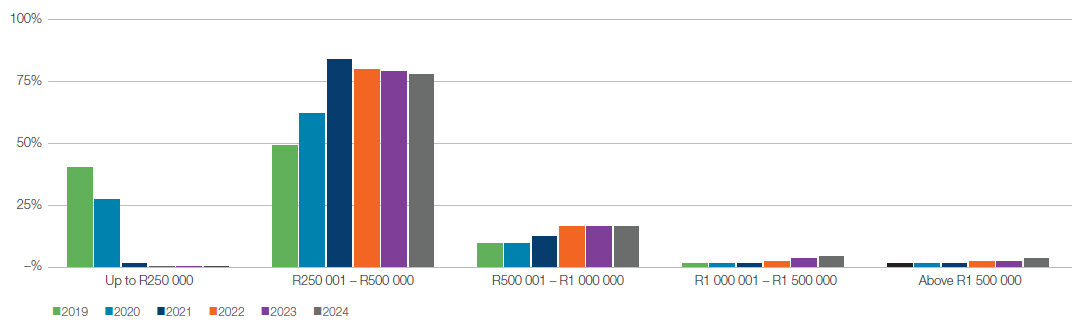
- Proactive measures
To prevent unjustifiable pay gaps, Implats has committed to:
- Annual fair-pay assessments
- Enhanced oversight of pay decisions
- Strengthened internal controls to uphold equitable practices.
These actions form part of our broader commitment to fairness, inclusion and responsible remuneration across the Group.
Performance management and cascading objectives
A robust performance management process is in place for all management employees, from junior manager level upwards. Each individual is assessed against a personal balanced scorecard (BSC), which cascades from the CEO’s deliverables and reflects the Group’s strategic priorities.
- The CEO’s performance is representative of overall Group performance and is assessed against strategic KPAs aligned with Implats’ six strategic pillars
- These objectives cascade through the executive team and management levels, ensuring alignment and accountability across the organisation.
The performance objectives cascades through the organisation in the following way:
| Group strategic objectives |
|
| CEO’s BSC |
|
| Exco members’ BSC |
|
| Operations |
|
Remuneration policy developments
Following significant enhancements in 2023 and 2024 – including the alignment of short- and medium-term incentives, recalibration of variable pay and refinement of long-term incentive (LTI) metrics – no major structural changes were introduced in FY2025. This marks a year of policy consolidation, with the framework now aligned to market best practice, sound governance principles and shareholder expectations.
The only amendment proposed relates to the minimum shareholding requirement (MSR) policy:
- Originally approved in 2018 and implemented from January 2019, the MSR requires executives to build a minimum shareholding over six years
- The first MSR cycle concluded on 31 December 2024, coinciding with a strong recovery in Implats’ share price
- The updated MSR policy (see Table 9 in the 2025 remuneration report) improves clarity and enforceability, ensuring practicality in volatile markets while maintaining alignment between executive and shareholder interests.
Performance-linked remuneration and strategic delivery
Performance-linked remuneration is directly influenced by:
- Operational delivery
- Cost discipline
- Market responsiveness.
These factors are discussed in detail in Chapter 4 and 5 of this report.
FY2025 performance highlights
Despite a challenging operating environment marked by depressed PGM pricing and restructuring costs, Implats delivered:
- Improved cash flow
- R8.1 billion in adjusted net cash
- R19.7 billion in liquidity headroom
- An 80.6% increase in share price, closing at R158.93.
These outcomes reflect strong financial stewardship and strategic resilience.
Safety performance
Safety remains a foundational value. In FY2025:
- LTIFR improved by 11% to 3.46 per million man-hours worked
- FIFR improved by 55% to 0.057
- A fatality modifier of -30% was applied, reducing the safety score from 200% to 170%.
Despite these improvements, eight fatalities occurred at managed operations (FY2024: 19; FY2023: 5), underscoring the continued urgency of achieving zero harm. Safer workplaces support consistent production and employee confidence, reinforcing the Group’s commitment to safe, sustainable production.
Production performance
- 6E production declined by 3% to 3.55 million ounces
- Managed production fell by 4%
- JV output decreased by 1%
- Refined 6E production remained stable at 3.37 million ounces.
These results reflect operational resilience amid processing constraints.
FY2025 Group performance rating outcomes prior and post upward discretion applied to the Group score
| Unit | Weight | Actual | Threshold % |
Target 100% |
Maximum 200% |
Bonus % achieved |
Moderated score |
|
| Group performance rating | 100% | 87 | 100% | |||||
|---|---|---|---|---|---|---|---|---|
| Safety LTIFR | per million | – | 3.45 | 4.52 | 4.07 | 3.62 | 200 | |
| Safety fatality rate modifier | – | (27)% | (40) | – | 100 | (30) | ||
| Safety | 15% | 170 | ||||||
| Turnover of critical skills | 10% | 6.40 | 8.38 | 7.94 | 7.53 | 200 | ||
| Mine-to-market 6E ounces in concentrate | 000oz | 35% | 3 345 | 3 104 | 3 449 | 3 621 | 70 | |
| Unit costs (working capital and stay-in-business capital) | R/6E oz | 25% | 23 736 | 25 258 | 22 962 | 21 814 | 66 | |
| Free cash flow | Rm | 15% | 2 354 | 2 010 | 8 670 | 11 980 | 5 |
Short-term incentive (STI) outcomes
Group performance against STI bonus parameters:
- Original score: 87%, consistent with FY2024.
Final score: 100%, following a 13% upward moderation to account for uncontrollable external factors.
Group and operational performance contribute 70% of the STI calculation for executive incentive scheme (EIS) participants, with the remaining 30% based on individual performance.
Individual performance measures
All management employees (junior manager level and above) are assessed against a personal BSC, with goals evaluated on a 1–5 scale:
- Score of 3: On-target performance (100% weighting)
- Score of 5: Exceptional performance (200% weighting).
A weighted average score informs individual STI outcomes.
Executive balanced scorecards (BSCs)
The executive balanced scorecards reflect the priorities of executive leadership and offer insight into how performance is measured, monitored and managed. By linking strategic goals to measurable outcomes, the BSCs reinforce accountability and support informed decision-making at the highest levels of the organisation.
EXECUTIVE BSCs
Personal performance measures: Outcomes for CEO, CFO and Group Executive: People
BSC for FY2025
CEO
| Performance measure | KPA and goal | Weighting % | Rating | Weighted rating |
Sustainability Sustainable development |
Improved safety performance | 15% | 3.50 | 0.53 |
Competitiveness and growth Operational excellence  Optimal capital structure  Competitive asset portfolio  Future focus |
Optimise our current PGM asset base by advancing consolidation of the Western Limb assets and by delivering an improved performance at the Styldrift operation | 40% | 4.50 | 1.80 |
| Forward looking strategic positioning and portfolio management by ensuring our portfolio comprises high quality assets, is well-positioned on the cost curve and delivers sustainable economic returns | 20% | 4.50 | 0.90 | |
| People excellence Operational excellence |
Strengthen leadership capacity, capability and resilience and ensure the attraction and retention of senior management skills to drive business growth and continuity | 20% | 4.50 | 0.90 |
| Stakeholder partnership Sustainable development |
Maintain and strengthen sound partnerships with key stakeholders | 10% | 4.30 | 0.43 |
| Total | 100% | 4.3 |
BSC for FY2025
CFO
| Performance measure | KPA and goal | Weighting % | Rating | Weighted rating |
| Sustainability Sustainable development |
Secure funding for renewable energy projects | 15% | 4.20 | 0.63 |
| Competitiveness and growth Future focus Optimal capital structure Competitive asset portfolio |
Strengthen the Group’s cash flow
position to ensure financial
resilience through the cycle Lead the commercial aspects in order to advance the consolidation of Western Limb operations |
50% | 4.50 | 2.25 |
| Financial system and structure Operational excellence |
Integrated and enhanced financial management system | 15% | 4.50 | 0.68 |
| People excellence Operational excellence |
Strengthen leadership capacity and capability | 15% | 4.50 | 0.68 |
| Total | 100% | 4.5 |
BSC for FY2025
Group Executive: People
| Performance measure | KPA and goal | Weighting % | Rating | Weighted rating |
| Sustainability Sustainable development |
Achieve a measurable
improvement in safety culture Create self-sustaining and inclusive mine communities through the implementation of the Implats social performance plan |
20% | 4.00 | 0.80 |
| Competitiveness and growth Operational excellence Optimal capital structure Competitive asset portfolio Future focus |
Lead the people, social and stakeholder aspects in order to advance the consolidation of the Western Limb operations | 30% | 4.30 | 1.29 |
People excellence Operational excellence |
Strengthen leadership capacity, capability and resilience and ensure the attraction and retention of senior management skills that support business continuity and strengthens our succession pipeline | 25% | 4.50 | 1.13 |
| Stakeholder partnership Sustainable development |
Maintain cordial stakeholder engagements with all mine-host communities, organised labour and employees, with the view to enhancing our stakeholder relations | 25% | 4.30 | 1.08 |
| Total | 100% | 4.3 |
Outlook: Futureproofing through strategic incentives
No major structural changes to the remuneration policy are anticipated for FY2026, aside from enhancements outlined in Table 9 of the remuneration report .
The board and executive leadership remain focused on futureproofing the business and ensuring its sustainability. This has informed robust debate on strategic direction for FY2026 and beyond.
FUTURE EVOLUTION OF REMUNERATION TO SUPPORT STRATEGIC SHIFTS
Implats’ remuneration framework is being continuously refined to support the Group’s evolving strategic priorities, particularly in response to:
- Future incentive structures will increasingly incorporate ESG-linked metrics, including decarbonisation, water stewardship and community impact
- Long-term incentives (LTIs) will be calibrated to reward progress in energy transition investments, with a target of 30% of enterprise value derived from these by 2035.
- As Implats shifts towards shallow, mechanisable and low-cost assets, performance metrics will evolve to reflect innovation, automation and productivity gains
- Remuneration will support the attraction and retention of digital and technical talent critical to modern mining operations.
- Incentive frameworks will be adapted to reward delivery against growth aspirations, including M&A integration, portfolio optimisation and strategic capital allocation
- Enhanced MSR will ensure stronger alignment between executive interests and long-term shareholder value.
- Continued emphasis on fair pay, diversity and inclusion will be embedded in remuneration practices, with targeted interventions to close unjustifiable pay gaps
- Leadership incentives will be tied to culture-building, safety leadership and transformation outcomes.

FY2026 BSC for the CEO, CFO and Group Executive: People
These strategic pillars inform the CEO’s deliverables for the year, which are cascaded to the rest of the Group’s executive and management teams. The FY2026 BSC for the CEO, CFO and Group Executive: People are reflected below.
BSC for FY2026
CEO
| Performance measure | KPA and goal | Weighting % |
| Responsible stewardship Sustainable development |
Deliver on our ESG commitments for FY2026 in line with approved budget | 15% |
| Competitiveness and growth Operational excellence Optimal capital structure Competitive asset portfolio Future focus |
Optimise our current PGM asset base by delivering improved production and cost performance across all operations Reposition our corporate strategy to ensure business sustainability and resilience by adapting to prevailing and emerging market trends |
40% |
| Competitiveness and growth Operational excellence |
Improve safety performance with a focus on fatal incident reduction | 20% |
| People excellence Organisational effectiveness |
Enhance leadership strength and resilience by building capacity, capability and pipeline of senior leadership talent, while ensuring their attraction and retention to support business optimisation, growth and continuity | 15% |
| Stakeholder partnership Sustainable development |
Maintain and strengthen sound partnerships with key stakeholders, ensuring stability in our operating environment | 10% |
| Total | 100% |
BSC for FY2026
CFO
| Performance measure | KPA and goal | Weighting % |
| Risk and security Operational excellence |
Strengthen financial and operational resilience by embedding robust cyber and risk management practices that safeguard business continuity, protect stakeholder value, and reinforce investor confidence | 20% |
| Competitiveness and growth Future focus Optimal capital structure Competitive asset portfolio |
Maintain strong liquidity and a resilient balance sheet in support of the cyclical nature of the PGM market | 30% |
| People excellence Organisational effectiveness |
Strengthen the finance function’s
capacity and capability to ensure
resilience and effective succession
and talent management, while
focusing on diversity, equity and
inclusion initiatives across all functions
within the finance portfolio Strengthen Fourth Industrial Revolution (4IR) practices within the business through the leadership of the Group IT function |
30% |
| Stakeholder partnership Sustainable development |
Maintain strong credit ratings and investor confidence relative to peers | 20% |
| Total | 100% |
BSC for FY2026
Group Executive: People
| Performance measure | KPA and goal | Weighting % |
| Responsible stewardship Sustainable development |
Drive responsible people practices by ensuring workplace inclusivity and ESG-linked workforce initiatives | 20% |
| Cultural transformation Organisational effectiveness |
Embed and sustain the Implats culture by aligning HR systems, leadership behaviours, and employee experience initiatives to drive a high-performance culture | 30% |
| People excellence Operational excellence Optimal capital structure Competitive asset portfolio Future focus |
Build leadership and organisational capacity by embedding succession, capability development, and retention initiatives that enable business growth and continuity | 30% |
| Stakeholder partnership Sustainable development |
Foster collaborative relationships with all internal and external stakeholders through effective engagement and communication platforms to ensure organisational stability | 20% |
| Total | 100% |