 Integrated Annual Report 2014
Menu
 Integrated Annual Report 2014
Menu
The Company is listed on the JSE Securities Exchange and has a sponsored Level 1 American Depositary Receipt programme in New York.
The underlying rationale for any enterprise is to create value for its stakeholders in a responsible and sustainable manner.
Effective risk management provides the requisite mitigation of the threats, weaknesses and uncertainties that may cause the enterprise to fail in the achievement of its objectives. Risk management must also establish how much uncertainty the enterprise is willing to accept in its endeavours.
Uncertainty presents both threats and opportunities with the potential to erode or enhance value. This is often expressed in terms of the concept of “risk versus reward”. Aversion to risk is incompatible with the creation of long-term value. Conversely, failure to conform to government, legal or social demands will result in severe and potentially damaging censure or even closure of the organisation.
In general, investors accept a measure of earnings volatility, particularly if such volatility reflects the nature of a company's industry. However, many stakeholders are not tolerant of what may be perceived as “risk taking” and may even punish uncertainty and unpredictability, which are interpreted as being indicative of an increase in risk.
Problems arise when a business' own view of its risk/reward status differs significantly from that of stakeholders. Effective and timely communication with stakeholders regarding relevant enterprise risk/reward issues is essential to mitigate stakeholder uncertainty and unpredictability.
Effective risk management enables management to deal with uncertainty and associated threats and opportunities, thus enhancing the enterprise's capacity to build value. At Implats this is achieved through:
The most important purposes of enterprise risk management are to institutionalise an ongoing and rigorous identification of risks in all aspects of the business, to encourage open and honest dialogue about these risks and to bring about the implementation of the necessary controls and risk-treatment initiatives.
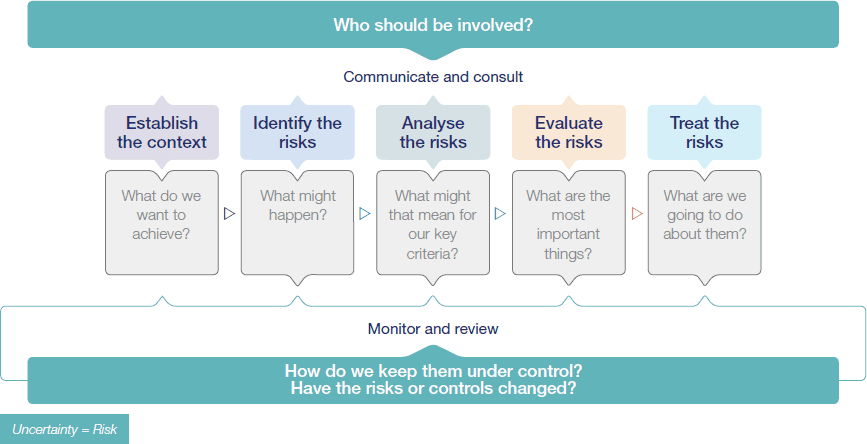
Effective enterprise risk management reduces uncertainty, engenders confidence and enables our organisation to be more decisive in pursuit of its vision, mission and goals. Group risk management policy and the ISO 31000 standard for risk management detail the systematic, consistent and professional approach that is required to ensure successful and effective risk management.
Implats Group Internal Audit (IGIA), is an independent and objective assurance provider. It provides reasonable assurance over the effectiveness of the internal controls and risk management. The department has delivered on its mandate, with a risk-based approach forming the basis of its methodology. All its audit activities were performed in compliance with the International Standards for the Professional Practice of Internal Auditing (the Standards) as provided by the Institute of Internal Auditors (IIA). The primary services provided by the department are:
The department continues to operate in accordance with its charter, which is updated annually and approved by the audit committee. The department is sufficiently skilled and supported by top management to deliver on its mandate. To remain an objective and independent assurance, the chief audit executive reports administratively to the CFO, holds quarterly meetings with the CEO and reports functionally to the chairman of the audit committee.
An effective quality assurance process is in place to ensure that Internal Audit provides its service in accordance with the standards and the internal audit code of ethics. The programme includes both internal and external evaluations, which assesses the effectiveness and efficiency of the internal audit activity, to identify opportunities for improvement, which are implemented and monitored by the department. The internal auditors in the department maintain membership with the Institute of Internal Auditors of South Africa, affiliated to the international body.
A Combined Assurance Model (CAM) as recommended by King III on corporate governance was established and it is coordinated by the chief audit executive (CAE). The CAM summarises the assurance activities in the organisation focusing on significant strategic and operational risks identified and listed in the group risk profile. It is therefore used as a foundation for both the annual written assessment on risk management and internal control prepared for the board as well as the statement on internal financial controls prepared for the audit committee.
The Implats board has overall responsibility to ensure that the internal control frameworks are adequately designed and effectively implemented throughout the Group. Effective internal controls are put in place to provide assurance that the Company's governance and risk managements are appropriately managed and that key business objectives are achieved. The board delegates the establishment and implementation of systems of internal control to members of executive management through a formal approval framework that is effected throughout Implats, revised, at least, on an annual basis.
Implats' internal controls are designed to mitigate strategic, operational and process risks to ensure that set strategic objectives are effectively and efficiently met. Accordingly, Implats management is responsible for the establishment, implementation, monitoring and enhancement of the internal control frameworks. The set key controls include, but are not limited to, financial and operational controls put in place to mitigate against the key risks as identified through processes facilitated by risk management. This is to ensure that Implats' assets are safeguarded and working capital is effectively managed and that set organisational policies, procedures, standards and guidelines are established, maintained and enhanced at appropriate times.
Implats maintained a CAM referred to above throughout the year. This model was established three years ago and has been improving year-on-year. This model continues to identify and exploit synergies amongst the three lines of defence (first line, management; second line, legal services, compliance, risk management and company secretariat; third line, internal audit, external audit and third-party assurance providers) in optimisation of the assurance provided in the Group. The CAM is presented to the CEO and CFO and discussed at the quarterly audit committee meetings. The first line of defence provides its input through the results of their Control Self-Assessments (CSAs).
We maintain zero tolerance on fraud and corruption. We expect all our employees, business partners, contractors and associates to conduct themselves in accordance with the Implats code of ethics referred to in the paragraph below and our fraud policy. The code and fraud policy are both fully in line with the local laws and regulations.
A “whistleblowing” toll-free helpline is in place to facilitate the confidential reporting of alleged incidents that are reported to the chief audit executive and the board chairman. The executives and line management are responsible and accountable for the implementation of the fraud policy, code of ethics and the procedures that flow from these policies.
In the current year 90 cases were reported across the Group, 50% of which were from the South African operation, 44% were from the Zimplats operation and the remaining 6% were from the Mimosa operation. This reflects a 35% reduction from last year's figure. The founded cases also decreased from 47% of total cases last year to 38% of total cases this year.
All reported allegations are investigated in compliance with our fraud policy. Of the 90 cases reported and investigated this year, four were classified as BEE fronting; 14 were conflict of interest and corruption; 45 were fraud and theft and 27 related to misconduct and other irregularities.
| Investigation pending |
Allegations unfounded |
Allegations founded |
Total | |
Nature of allegation |
||||
| BEE fronting | 1 | 1 | 2 | 4 |
| Conflict of interest and corruption | 7 | 5 | 2 | 14 |
| Fraud and theft | 9 | 15 | 21 | 45 |
| Misconduct and other | 7 | 11 | 9 | 27 |
| Total | 24 | 32 | 34 | 90 |
Implats has a code of business practice to which all employees and suppliers are expected to adhere. The policy outlines conflicts of interest, the prevention of dissemination of Company information, the acceptance of donations and gifts and the protection of the Company's intellectual property and patent rights. This policy outlines the disciplinary action (including dismissal or prosecution) that will be taken in the event of any contravention. A “whistleblowing” toll-free helpline is in place to facilitate the confidential reporting of alleged incidents that are then relayed to the chief audit executive, and further to the chairman of the board as a courtesy. All reported allegations are investigated, each to its logical conclusion and formally reported to the appropriate levels in the organisation.
The Group observes closed trading periods from the end of the relevant accounting period to the announcement of the interim or year-end results and any period when the Company is trading under cautionary announcement, during which periods neither directors nor employees may deal, either directly or indirectly, in the shares of the Company or its listed subsidiaries.
Certain employees, by virtue of their positions or access to information, are also prohibited from trading during certain periods when they are in possession of unpublished price-sensitive information. The Morokotso Trust is only allowed to trade during closed periods in respect of shares vesting for good leavers. The Trust is not a share incentive scheme in terms of the JSE Listings Requirements and the provisions of Schedule 14.9(d) do not apply to the Trust.
All directors' dealings require the prior approval of the chairman while the Group secretary retains records of all such dealings and approvals. A formal policy in respect of the trading of the Company's shares and securities regulates the Company and its employees in this regard.
Implats' non-financial information and performance is guided by Group-wide definitions and reporting procedures informed by international reporting guidelines and transparency codes such as the Global Reporting Initiative (G3.1), the United Nations Global Compact, the Extractive Industries Transparency Index (EITI), the JSE Social Responsibility Index (SRI) as well as laws and regulations governing the country of operation. Material sustainability information is managed as a fundamental part of the business against set standards and objectives and reported to the relevant operational committee, and to the board via the sub-committees. Sustainability performance is reviewed on a regular basis and the necessary corrective actions and measures taken where required.
Group policy prohibits political donations, either directly or indirectly.
Implats has complied with the requirements of the Promotion of Access to Information Act, 2000. The corporate manuals are available on the website at www.implats.co.za and from the Group secretary who has been appointed the information officer of the Group.
Deutsche Securities (SA) Proprietary Limited is appointed the Company's corporate sponsor, in compliance with the JSE Listings Requirements.