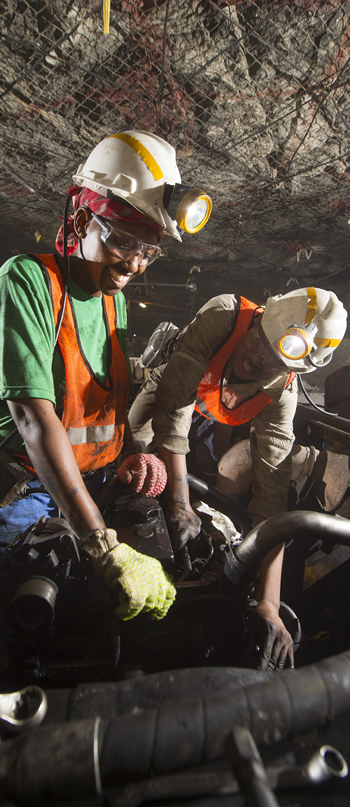
Our focus on employee relations for 2015 and beyond
Our immediate priority in the months ahead is to resume production at our operations, in a safe and sustainable manner, and ensuring that our mines are financially viable, in the context of low metal prices and increasing costs.
In terms of delivering on our ER strategy, we recognise the need to operate at both an informal and formal level. Implementing our strategy will encompass a range of activities over the short and medium term.
- Continuing discussions on key issues: As part of the agreement that ended the strike, we have committed with all other parties to continue talks on various outstanding issues including: the management of microloans and garnishee orders; the nature of the medical separation agreement; the retrenchment agreement/severance policy; retirement benefits and funeral cover; sub-contracting, labour hire and employment agencies; job grading review; employee shareholding; medical aid; and the establishment of a life skills centre. We have established internal teams to represent the Company with responsibility for driving these issues, both at a plenary negotiation level and within specific task teams. Through our representation on these teams we will be seeking to add to an attractive value proposition for our employees that management, employees and unions perceive as fair and that, collectively, we can be proud of.
- Enhancing relationships: We will continue to drive various initiatives aimed at building better relationships across the organisation. As part of our drive to win over the hearts and minds of employees, we will be implementing a new employee engagement model, presenting an attractive value proposition to employees, and developing new values through the Respect, Care and Delivery initiative that we commenced throughout the Group in August 2013, but that was disrupted at the Rustenburg operation during the strike. The aim of this initiative is to work with our employees towards establishing a shared value system. In addition we will be working to entrench a spirit of partnership with our recognised unions, by seeking to extend the common values shared with our employees to the institution of the union. By working together we will be seeking to develop a shared agenda with the union, especially in terms of employee wellness and the upliftment of employee living and social conditions. We recognise that this will require effective communication and active engagements with union representatives.
- Building capacity: To achieve the necessary shift in culture throughout the organisation we will be working to enhance the knowledge, skills and attributes of managers, employees and their representatives. A crucial initial focus will be the development and empowerment of our first line managers. We will seek to implement a robust process of training, particularly in the areas of people management, coaching, developing subordinates and handling employee grievances. Our aim is to develop a new breed of managers who pride themselves in being ‘leaders of men' rather than ‘masters that have to be served'. At the same time we will be working with our employee representatives and leaders to provide them with further training and awareness-raising on relevant legislation and Group policies and procedures.
- Changing the boundaries and shifting the paradigms: Recognising the need for a structural change in our approach to employee relations in South Africa, we shall continue to participate actively in relevant forums at the Chamber of Mines, including those relating to: the migratory labour system; the nature of majoritarian system; labour hire and employment agencies; the secondment of shop stewards to the regional and national institutions of the union; the establishment of life skills centres; and mining housing initiatives.
- Maintaining solid industrial relations in our Zimbabwe operations: In Zimbabwe our focus will continue to be on striving to resolve IR issues swiftly in-house, strengthening internal communication structures to enhance the effectiveness of the Company's works councils, and building trust at all levels of the organisation.
Looking to the future, an important lesson that we have taken from the strike is that the current industrial relations landscape and mining model cannot continue. Addressing the challenges raised by the strike will require more than changes to our employee relations strategy alone. It will require us to revisit our approach to the migratory labour system, to work on transforming the low skill, low paying, labour-dependent mines, and to continue with our significant social investments in housing and education. We recognise that we cannot deliver these issues on our own, and that we need to work actively with our industry partners, government, union leaders and other stakeholders.
 Sustainable development
2014
Menu

 Our immediate priority in the months ahead is
to resume production at our operations, in a
safe and sustainable manner