SAFE AND EFFECTIVE PEOPLE WHO RESPECT AND CARE
safety
 In seeking to mitigate safety risks in the
workplace, an ongoing focus is to increase
supervision and leadership skills and implement
best practice
Key leading indicators
- A total of 52 stoppage instructions (excluding Section 55s) were issued by the DMR in 2014 (2013: 65), resulting in the relevant shaft being closed for a period. All shafts collectively lost approximately 205 shaft days of production at our Rustenburg operations, and 29 days at Marula (compared with 261 and 21 days respectively in 2013). We continue to engage actively with the authorities on these stoppage instructions, including challenging them legally where we feel this to be justified. While we support all safety work stoppages where its condition or behaviour has been identified that poses a direct danger to safety, extending these stoppages beyond the scope of the risk is problematic and in certain instances may have a negative impact on safety performance.
- Our internal safety stoppage system, formalised in 2013, recorded a total of 2 562 proactive stoppages made in workings during 2014, compared to 3 528 in 2013.
- We achieved 95.2% compliance in our road behaviour testing, as compared with 91% last year; despite this improvement, we fell short of our target of 100%.
- We conducted 810 138 breathalyser tests throughout our operations in line with Company policy of zero alcohol in the workplace. As a result, 498 tested positive, representing a 42% decrease on the number of individuals testing positive in 2013; disciplinary action has been taken against all employees testing positive.
During the year, seven potentially serious safety incidents occurred, during which no injuries were sustained. In each case, an investigation into the root cause was conducted and remedial actions undertaken. Tragically, two critical incidents occurred on the lease area during the year, both of which involved the death of a child of our employees. At Rustenburg's 6 Shaft Hostel, a one-year-old toddler was fatally run over. At our new Platinum village development, an eight-year-old boy drowned in a flooded excavation trench. The investigations revealed a number of control deficiencies, which have been addressed through a joint AMCU management forum.
Our safety focus for 2015 and beyond
We have prioritised the following strategic objectives and focus areas for safety in the year ahead:
- Culture shift: Shifting the safety culture through leadership, using the Mine Health and Safety Council's Five Pillar Cultural Transformation Framework (CTF), remains an ongoing priority. This will include using opportunities presented through the revised health and safety agreement with all employee representative groups, to engage more effectively with employees in promoting the right safety culture.
- Normalise the industrial relations environment: From a safety perspective, we will ensure that senior management engage with supervisors to contextualise the recent and ongoing challenges and provide support for effective supervision. We will continue to pursue interactions with senior union leadership to gain commitment for safety initiatives.
- Supervision and technology: In seeking to mitigate safety risks in the workplace, an ongoing focus is to increase supervision and leadership skills and implement best practice technical initiatives.
- Safety performance measures: We will further develop leading indicators and increase the safety weighting in short-term incentive schemes.
- Targets: In striving for zero fatalities and zero harm, we will continue to focus on ensuring that all operations have behaviour-based safety programmes in place. Each operation is expected to achieve at least a 20% improvement in their LTIFR performance. In addition, we will strive to achieve: 100% compliance with road behaviour; 100% compliance with platinum rule or 100% disciplinary action for non-compliance, to these rules.
Fatal injury frequency rate (FIFR)
| Per million hours worked |
2014 |
2013 |
2012 |
2011 |
2010 |
| Impala Rustenburg |
0.052 |
0.091 |
0.115 |
0.061 |
0.166 |
| Impala Springs |
0.000 |
0.000 |
0.000 |
0.000 |
0.000 |
| Marula |
0.000 |
0.000 |
0.13 |
0.000 |
0.000 |
| Mimosa |
0.000 |
0.000 |
0.000 |
0.100 |
0.000 |
| Zimplats |
0.068 |
0.000 |
0.000 |
0.000 |
0.000 |
| Group |
0.043 |
0.065 |
0.087 |
0.053 |
0.122 |
 |
A total of 52 stoppage instructions were issued in 2014 (2013: 65) |
|
We achieved 95.2% compliance in our road behaviour testing, as
compared with 91% last year |
Notable safety achievements
| |
Operation |
|
Achievement |
| |
Impala 4 Shaft |
|
1 million fatality-free shifts |
| |
Impala 11 Shaft |
|
1 million fatality-free shifts |
| |
Impala 14 Shaft |
|
2 million fatality-free shifts |
| |
Marula |
|
2 million fatality-free shifts |
| |
Zimplats |
|
A 41.4% improvement in their LTIFR to 0.41 per million man-hours worked |
| |
Afplats shaft sinking operation |
|
A 89.8% improvement in their LTIFR to 1.79 per million man-hours worked |
| |
Springs Refinery |
|
A 38.1% improvement in their LTIFR to 0.26 per million man-hours worked |
| |
FIFR (per million hours worked) |

|
|
| |
LTIFR (per million hours worked) |
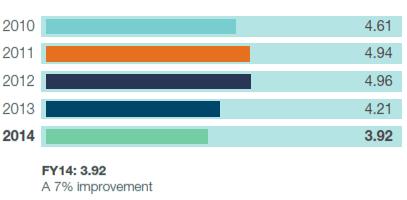 |
| |
RIFR (per million hours worked) |
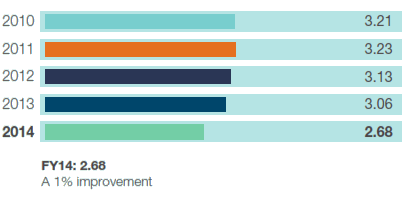 |
|
| |
TIFR (per million hours worked) |
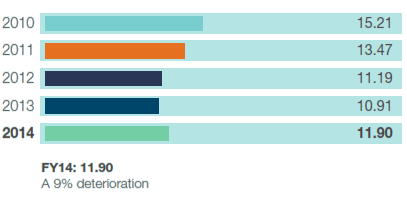 |
| |
Comparison of fatality rates (calendar years) across the South African platinum industry (per million man-hours worked) |

 Sustainable development
2014
Menu
