
Annual Integrated Report for the year ended 30 June 2024
Annual Integrated Report for the year ended 30 June 2024

THANDI ORLEYN, CHAIRMAN
The Group delivered a strong production, cost and sales performance for FY2024 against a highly challenging backdrop, and despite a lengthy safety stoppage following the Impala Rustenburg 11 Shaft tragedy.
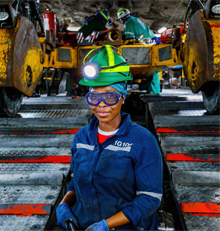
Implats can be proud of its status as a leading, integrated and responsible PGM producer, guided by clear strategic aspirations which prioritise sustainable development, operational excellence, organisational effectiveness, an optimal capital structure, and a competitive asset portfolio while maintaining a future focus.
Pricing for platinum group metals (PGMs) remained weak throughout the period, heavily impacted by industrial and automotive destocking and poor investor sentiment amid the uncertain macro-economic and geopolitical landscape, which significantly affected the Group’s financial performance. However, disciplined capital management and prudent capital allocation, together with the Group’s foresight to harness the benefit of past financial windfalls delivered by the recent PGM pricing upcycle to strengthen its balance sheet, resulted in the Group closing the period well-positioned and resilient in the current difficult operating environment.
Global challenges resulted in a bumpy and uncertain year for businesses and countries alike. FY2024 was characterised by escalating geopolitical tensions and conflicts, slowing economic growth, still-high inflation, tightening monetary policy, debt sustainability challenges and ever-worsening climate shocks which further complicated the global economic outlook and threatened development gains.
The International Monetary Fund’s (IMF’s) July 2024 World Economic Outlook projects annual average global growth to remain stable at 3.2% in 2024 and 3.3% in 2025. Increased protectionism and the gradual dismantling of global multilateral trading systems are key concerns, and the World Bank has called for global cooperation to safeguard trade, support green and digital transitions, deliver debt relief and improve food security. In emerging markets, significant public investment is needed to boost productivity, enhance business dynamism, stimulate private investment and revitalise flailing medium-term growth prospects.
Domestically, the incidence of electricity loadshedding has improved significantly, however, South Africa continues to face challenges associated with electricity, water, transport and logistics infrastructure, increasing the financial burden borne by the private sector. The IMF has reiterated its view that an ambitious structural reform programme is required to address the challenges faced by South Africa’s economy to remove bottlenecks to growth and to put public debt on a sustained downward path through fiscal consolidation. Its July 2024 forecast, however, projects higher South Africa’s economic growth than its previous view a year ago at 0.9% in 2024 and 1.2% in 2025. Business is hopeful South Africa’s newly installed government of National Unity provides the reforms necessary to put the country back on the global map, attract investors and kickstart jobs-rich economic growth, and is committed to working together to realise these goals.
Against this backdrop, Implats delivered a creditable performance in the year, with strong production and commendable cost control supported by disciplined capital management and prudent capital allocation, enabling the Group to retain a strong balance sheet and sustain its commitments to its stakeholders.
Read about Implats’ strategic response to the low metals price environment in our CEO’s review on page 76.
A key highlight during the year was the progress made in broadening the economic participation of key stakeholders in our South African mining and processing assets.
Community and employee ownership delivers significant socio-economic benefits, fosters a common goal to create sustainable operations for the benefit of all stakeholders, and advances Implats’ stated purpose – to create a better future. The strategic broad-based black economic empowerment (B-BBEE) transaction reported on previously was concluded at Impala, including Impala Refining Services, and Impala Bafokeng which broadens ownership in our mine-to-market PGM value chain. Equity ownership in each of the two companies is via employee share ownership trusts (ESOTs), a strategic empowerment consortium, and a community share ownership trust (CSOT) resulting in 13% B-BBEE participation. The CSOT includes a broad range of beneficiaries from the mine-host communities and will focus on investing dividends received from equity participation in education and skills development, enterprise development, community wellbeing and social and economic infrastructure for the benefit of those communities.
Meanwhile, following approval of Zimplats’ empowerment plan by the Zimbabwean government in 2022, Zimplats has issued equity in its empowerment companies to a CSOT. Future dividends are committed to ensuring communities realise tangible benefits from their ownership in these companies.
Shareholders and investment rating agencies have rightly placed an increased focus on fair and responsible pay practices. We wholeheartedly agree with this emphasis and our leadership is committed to ensuring fair and responsible remuneration is applied across the Group. ESOTs are just one of the mechanisms used to support this commitment and increase economic inclusion.
We were gratified that these efforts were recognised in the year under review. Implats had a major presence, and was jointly awarded an honour at the Department of Trade, Industry and Competition’s inaugural Worker Share Ownership Conference in April 2024. The Group’s Impala ESOT jointly won the Outstanding Dividend Distribution Award, recognising a strong commitment to maximising returns for employee-owners. In addition, the Impala ESOT and the Marula ESOT were nominated for awards for the Largest Number of Beneficiaries and Top Champion for Women and the Best New Entrant and Innovation Award, respectively.
I am pleased to report another year of excellent progress in Implats’ sustainability journey. The Group’s sustainability activities and initiatives contribute towards 14 of the United Nations’ Sustainable Development Goals (SDGs), which inform Implats’ short to medium-term strategy and underpin its goal to create long-term value.
Several prestigious accolades were attained and retained during the year, underscoring the Group’s commitment to excellence in ESG management, transparency and reporting. Implats’ annual S&P Global Corporate Sustainability Assessment score for the Dow Jones Sustainability Index (DJSI) was 61 out of 100 (FY2023: 66 out of 100), ranking it in the 93rd percentile of the mining and metals industry, and we earned our third consecutive inclusion in S&P’s Global Sustainability Yearbook (2024), a distinction reserved for top-performing companies.
The Group achieved an overall BBB rating from MSCI, reflecting both excellent environmental and social performance and strong governance structures, as well as an ‘A-’ rating for water security risk management, and a ‘B’ rating for climate change action and disclosures – both from the Carbon Disclosure Project (CDP). Implats remains a constituent of the FTSE4Good Index Series, the FTSE/JSE Responsible Investment Top 30 Index while Impala Refineries holds the London Palladium and Platinum Markets Responsible Sourcing Standard certificate. All operations, bar Impala Canada, are ISO 14001:2015 certified, Impala Refineries, Marula and Zimplats are ISO 45001:2018 certified and Impala Refineries holds ISO 9001:2015 certification.
Operational excellence necessitates a commitment to safe production practices. The improvements recorded in the Group’s lost-time injury and total injury safety metrics during the period were overshadowed by the devastating tragedy at 11 Shaft at Impala Rustenburg in November 2023, in which 13 employees lost their lives, and the six unrelated safety incidents which claimed a further six employees at our managed operations in the year. The board expresses its profound regret over these fatalities while maintaining rigorous oversight of the interventions designed to enhance Implats' safety performance.
The Group employs a proactive clinical strategy to manage both occupational and non-occupational health risks, which includes effectively responding to on-site injuries and monitoring chronic diseases and mental wellbeing. Significant progress was made during the year in implementing targeted interventions aimed at mitigating the primary health risks faced by employees, with an increased focus on addressing both mental wellbeing and the rise in lifestyle diseases.
Implats seeks to leave a lasting positive legacy in the communities in which it operates. Mine communities, especially in southern Africa, face major socio-economic challenges and have become increasingly dependent on mining companies for the provision of basic socio-economic needs. Increasingly, severe weather events, and long-term cyclical droughts arising from climate change have served to reduce yields from subsistence agriculture, further threatening both water and food security for many of our mine communities.
Implats is committed to sharing the economic value it creates in a bid to create self-sustaining communities, beyond mining.
The focus is on key, high-impact and strategic community investment projects aligned with community needs. During FY2024, Implats spent R375 million on projects focused on community wellbeing, education and skills development, enterprise development, inclusive procurement and developing resilient infrastructure, which together benefited more than 140 000 people and supported approximately 4 800 employment opportunities. We invite you to read our accompanying 2024 ESG report, where the Group’s social performance activities are more fully explored on page 31.
Implats has committed to decarbonising its operations to achieve carbon neutrality by 2050, with a short-term target to reduce carbon emissions by 30% by FY2030 against its FY2019 baseline. Significant progress was made on increasing access to renewable energy, despite the deferral of project spend because of the depressed metals price environment. Zimplats completed the first 35MW of its intended 185MW solar power complex, which was successfully commissioned post-year-end.
Responsible water stewardship is a strategic priority, and Implats’ water stewardship framework aligns with global frameworks and provides guidance on managing water-related risks and associated capital allocation decisions. The Group has deepened its understanding of the climate change-related issues critical to the security of water supply, compliance, efficiency and integrated management. Our southern African operations are in water-scarce regions, underlining the importance of minimising freshwater withdrawals and increasing both water recycling and re-use. Several initiatives to improve water management, security and water-use efficiencies for operations, and infrastructure projects to ensure access to clean water for employees and local communities are ongoing. Implats is advancing its journey towards biodiversity mainstreaming and supports the International Council on Mining and Metals’ (ICMM) Global Industry Standard on Tailings Management, with all Group operations subject to annual reviews by an independent tailings review board. Read more about our environmental performance from page 67 of our ESG report.
At Implats, we are dedicated to upholding the highest standards of corporate governance and adhering to the principles outlined in the King IV Code of Corporate Governance for South Africa. This commitment encompasses effective, responsive, and adaptive stakeholder engagement, with a strategy that aligns with the principles of materiality, completeness, and responsiveness, in line with both King IVTM and the AA1000 Assurance Standard.
Adherence to host-country regulations, together with consistent and respectful engagement with regulators remains a key focus for Implats. The Group complies with South Africa’s Mineral and Petroleum Resources Development Act (MPRDA) and is committed to fulfilling the expectations outlined in the B-BBEE Charter for the South African Mining and Minerals Industry, as well as the Mining Charter. In Zimbabwe, Zimplats actively monitors policy developments, engages closely with the government directly and through industry bodies, and takes a leading role in fostering industrial linkages. Impala Canada maintains active membership in the Ontario Mining Association to build consensus with the government on industry-related matters.
The Group enjoys cordial and maturing stakeholder engagement through established structures at all operations. See page 47 in this report, while additional information is available in our ESG report from page 15.
Over the past several years, Implats has navigated a series of external shocks – the impacts of Covid-19, subsequent supply-chain imbalances, armed conflict in Europe and the Middle East which spurred energy inflation and, in southern Africa, severe weather events and infrastructure failures.
The near-term macro-economic outlook remains uncertain, suggesting a period of stable but slow growth. Inflation, and hence interest rates, should gradually decrease, albeit with varying pace, impacts and implications across different regions. Policymakers will need to navigate these dynamics carefully to maintain economic stability and growth prospects.
PGM miners continue to face challenging – and sometimes competing – stakeholder expectations from host communities, governments, organised labour and investors. Implats will continue to prioritise labour stability, and constructive engagement with mine communities, regulators and other key stakeholders amid persistent socio-economic challenges and financial constraints across our operating geographies.
Our focus on delivering improved safe and consistent production remains paramount. Each of the Group’s assets is being positioned to perform more competitively in a difficult operating environment and the Group is responsibly advancing its planned projects pipeline, with a prudent approach to capital investment amid constrained profitability.
With a strong and capable management team and a fit-for-purpose strategy, Implats remains guided by its overriding purpose – to create a better future through the responsible and ethical way it conducts its business, the future-focused metals it produces, and sustaining excellent performances across all spheres of our business.
On behalf of the board of directors, I thank all Implats employees for their ongoing dedication to securing a long-term and sustainable future. I also extend my heartfelt appreciation to my fellow board members and the Implats’ management team. Thanks to the tremendous efforts of Implats’ people, the Group remains agile and resilient.
Adv Thandi Orleyn
Chairman